What Is a Power Plate? The Complete Guide to Vibration Training
A Power Plate is a vibration platform. You stand or exercise on it while it moves many times per second, and your muscles answer with fast reflex contractions. It will not replace real training, but used well it makes a short session harder, can help some people with balance and leg strength, and feels good as part of a warm-up or cool-down.
This guide covers how a Power Plate works, what the research supports and what it does not, how to use one for different goals, and who should skip it.
The short version
- A Power Plate is a brand of whole-body vibration platform. The vibration makes your muscles work harder during simple exercises.
- The best-supported uses are leg strength and balance, especially for older adults and people new to exercise.
- Claims about fat loss and bone density run ahead of the evidence. Treat it as an add-on, not a shortcut.
- Sessions are short: 10 to 20 minutes including rest, two or three times a week, starting on low settings.
- Some people should not use one without medical clearance, including anyone pregnant or with a pacemaker.

What is a Power Plate?
Power Plate is the best-known brand of whole-body vibration machine. People often use the name for any vibration plate, the way people say Kleenex for tissues. You will find them in gyms, physical therapy clinics, some building gyms and a growing number of homes.
All vibration plates do the same basic thing: the platform moves fast and in small increments, and that movement passes into your body. Where they differ is how they move.
- Vertical (linear). The platform moves mainly up and down, and both feet move together. Power Plate belongs here. It markets its motion as multidirectional and calls it PrecisionWave, but independent measurements show the movement is mostly up and down.
- Pivotal (side-alternating or oscillating). The platform tilts like a seesaw around a center line, so one foot rises as the other drops. Many lower-priced home plates work this way.
Up-and-down plates send more vibration toward the head than seesaw plates, which is one more reason to keep your knees soft.
Two settings control how hard it feels. Frequency is how many times per second the plate moves, measured in hertz (Hz). Power Plate models run between 25 and 50 Hz depending on the model, and seesaw-style plates often run lower. Amplitude is how far it moves each time. On a Power Plate it is a simple low or high setting; on a seesaw plate it grows the farther apart your feet are. Raising either one makes the session more intense.
What your body does on the plate
Each tiny movement of the platform briefly stretches your muscles, and stretch sensors in the muscle trigger quick reflex contractions in response. Researchers often link this to the tonic vibration reflex, although exactly how it works during whole-body vibration is still being studied. That extra muscle activity is why a simple squat hold on a Power Plate feels harder than the same hold on the floor.
Combined with a short-term rise in blood flow, that may also be why the plate can leave you feeling warm, loose and a little more awake. Technique matters too: a locked knee or a stiff body lets more of the vibration travel up toward your head, which is uncomfortable and not something you want.
What the research supports, and what it does not
There is real research on whole-body vibration, but most studies are small, use different machines and settings, and compare vibration to doing nothing rather than to good training. Here is the honest picture.
| Goal | What studies suggest | Bottom line |
|---|---|---|
| Leg strength and power | Small to moderate gains, mostly in older adults and people new to exercise. In trained people, results look similar to doing the same exercises without vibration. | A useful add-on, not a replacement for lifting. |
| Balance and fall risk | Several trials in older adults show better balance and mobility scores after regular sessions, and a few report fewer falls, though the evidence on falls is limited. | One of its best-supported uses, ideally with supervision. |
| Bone density | Mixed. Some studies in postmenopausal women show small benefits at the hip or spine; others show none. The positive results mostly come from long programs on gentle, low-intensity plates, not typical gym sessions. | Not a substitute for strength training, impact work and medical care. |
| Flexibility | Stretching on the plate, or right after it, can improve range of motion in the short term. | Good for warm-ups and stretching sessions. |
| Soreness and recovery | Some studies report less muscle soreness after hard exercise. | A pleasant recovery tool. |
| Weight loss | Little evidence on its own. Standing on a plate burns few calories. | Results come from training and nutrition. |
| Circulation | Blood flow in the legs rises during use. | A short-term effect that helps explain the warm, loose feeling. |

Power Plate vs. traditional training
The question is rarely one or the other. A Power Plate is good at a few specific things, and traditional training does everything else.
| Power Plate | Traditional training | |
|---|---|---|
| Time per session | 10 to 20 minutes | 30 to 60 minutes |
| Strength building | Modest, best for beginners and older adults | Proven at every level, because you can keep adding load |
| Heart and lung fitness | Very little | Strong, from running, cycling, intervals and circuits |
| Stress on joints | Low impact | Varies, and can be scaled down |
| Balance and coordination | Good for static balance | Better for movement skills you use in daily life and sport |
| Access | Needs the machine | Needs little or no equipment |
The practical answer is to use both: traditional strength and cardio work as the base, with the plate added for warm-ups, balance work, stretching or recovery.
How to use a Power Plate for different goals

As a warm-up
Two to five minutes on a low setting gets blood moving and wakes up the muscles you are about to use. Try slow bodyweight squats, calf raises, hip hinges and gentle lunges, 30 seconds each, with soft knees throughout. Then move on to your main workout.
For strength
Most bodyweight exercises work on the plate, and the vibration makes each one harder. Good starting moves:
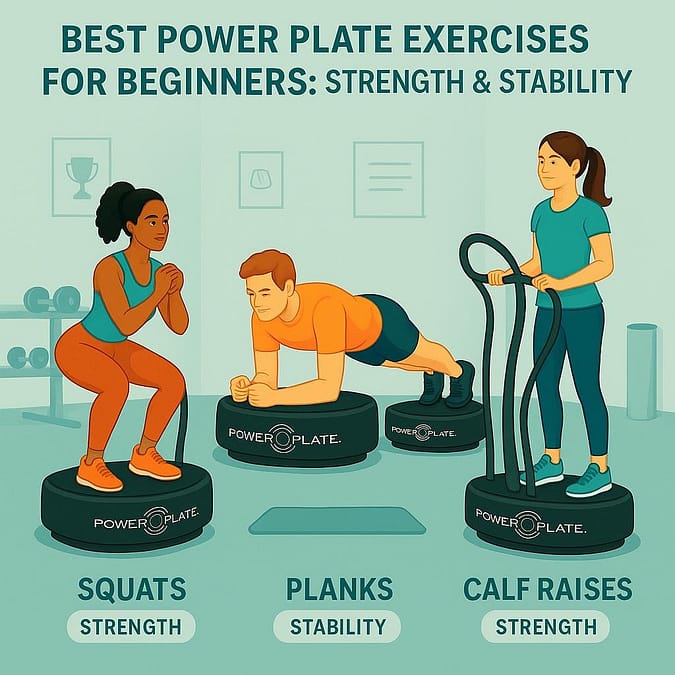
- Squat hold or slow squats, knees soft and your weight toward the front half of your feet, not back on your heels
- Split squat with the front foot on the platform
- Push-up or plank with your hands or forearms on the platform
- Glute bridge with your feet on the platform
- Triceps dip with your hands on the edge of the platform
Work for 30 to 60 seconds and rest for the same time. For step-by-step moves, see our guide to the best Power Plate exercises for beginners. Once those feel easy, our advanced Power Plate workouts add load, tempo and harder positions.
For flexibility and stretching
Vibration seems to make stretching feel easier, so many people find they reach a little further on the plate. Hold each stretch for about 30 seconds on a low setting:
- Hamstrings: heel on the platform, leg straight but not locked, hinge forward from the hips
- Calves: stand on the floor facing the plate, put the ball of one foot on the edge of the platform with your heel on the floor, and lean gently forward
- Hip flexors: back knee on a mat, front foot on the platform in a lunge
- Chest and shoulders: hands on the platform with elbows soft, walk your feet back and let your chest sink
If stretching is the part you never get to, our assisted stretching sessions do it for you at home.
For recovery and massage
After a hard session, lie on a mat beside the plate and rest your calves or hamstrings on the platform. Use a low setting for 30 to 60 seconds per area, and keep your head, neck and upper back off the platform. Many people report less soreness the next day.
For stress relief
A massage program, if your plate has one, plus a few minutes of easy movement can feel calming, and some people use the plate as a short reset at the end of the day. Research on stress itself is thin, so treat this as a pleasant habit rather than a treatment.
For weight loss
A Power Plate will not melt fat on its own. Where it helps is making a short strength circuit harder, so you get more work done in the same time. Fat loss still comes from regular training, daily movement and what you eat. If that is the goal, our weight loss personal training builds all three into one plan.
For rehab and joint health
Some physical therapists use vibration platforms to get muscles working without heavy loads or impact, and they may have a place after an injury once your doctor or therapist clears you. Settings stay low, sessions stay short, and someone qualified should choose the exercises. For aches that keep coming back, a corrective exercise assessment looks at the movement patterns behind them.
Power Plate for seniors
Older adults are the group with the strongest case for vibration training. Short, regular sessions may support leg strength and balance, two things that help you stay steady on stairs, curbs and subway platforms, and the work is low impact.
A few rules make it safer:
- Hold the handles lightly for balance on every standing exercise, elbows soft, without leaning or hanging on them.
- Start on the lowest frequency and amplitude, and keep the first sessions to about 10 minutes.
- Keep knees and hips slightly bent. Never stand with locked joints.
- Get medical clearance first if you have osteoporosis, a joint replacement, a heart condition or balance problems.
- Stop if you feel dizzy, numb or unwell.
A simple starting routine: two minutes of marching on the spot, then squat holds, calf raises and side-to-side weight shifts for 30 seconds each, repeated twice, with a calf massage to finish. For exercises that need no machine at all, see the best strength training exercises for seniors, or learn how our senior personal training works.
Getting started: settings, time and how often

- Session length: 10 to 20 minutes, including rest, is plenty. With equal work and rest, that is only about 5 to 10 minutes of actual vibration. More is not better.
- How often: two or three times a week, with a day off in between.
- Each exercise: 30 to 60 seconds, with equal rest.
- Settings: start low on both frequency and amplitude. Raise one at a time, only when the current level feels easy.
- Footwear: wear supportive athletic shoes for standing exercises.
- Setup: place the machine on a flat, solid floor and read the manual for your model.
A first session might look like this:
| Exercise | Time | Setting |
|---|---|---|
| Marching and slow squats (warm-up) | 2 minutes | Low |
| Squat hold | 30 seconds, then rest 30 | Low |
| Push-up, hands on the platform | 30 seconds, then rest 30 | Low |
| Forearm plank on the platform | 30 seconds, then rest 30 | Low |
| Glute bridge, feet on the platform | 30 seconds, then rest 30 | Low |
| Split squat, each side | 30 seconds each, then rest 30 | Low |
| Hamstring and calf stretch | 1 minute | Low |
| Calf massage, lying on a mat with calves on the platform | 1 minute | Low |
Common mistakes to avoid
- Locking your knees or elbows. Straight, stiff joints send more vibration toward your head. Keep everything slightly bent.
- Leaning back on your heels. It sends more vibration up toward your head. Keep your weight toward the front half of your feet.
- Starting on high settings. Intensity builds quickly. Begin low and progress over weeks, not sessions.
- Staying on too long. Long sessions add fatigue and discomfort without extra benefit.
- Adding heavy weights too soon. Master bodyweight moves first, then add light dumbbells or bands.
- Jumping on the platform. Plyometric work on a moving surface is an injury risk. Do it on the floor.
- Treating it as your whole workout. It cannot build heart and lung fitness or full-body strength on its own.
- Pushing through warning signs. Dizziness, numbness, headache or joint pain mean stop.
Who should not use a Power Plate without a doctor’s OK
Vibration training is not for everyone. Talk to your doctor or physical therapist first if any of these apply:
- Pregnancy
- A pacemaker or other implanted electronic device
- Recent surgery, fresh wounds or stitches
- A joint replacement or metal pins, plates or screws
- A blood clot now or in the past, or a clotting disorder
- Serious heart or blood vessel disease, or uncontrolled high blood pressure
- A recent fracture, or osteoporosis
- Active cancer or a tumor
- Diabetes, especially with numbness or nerve damage in the feet
- A recently placed IUD or a stent
- Epilepsy
- An acute hernia, or disc problems in your back
- Kidney stones or gallstones
- Recent eye surgery or a history of retinal detachment
- Severe migraines
- An acute injury, infection or inflammation
This list follows common manufacturer guidance and is not complete. Your doctor has the final say.
Frequently asked questions
Does a Power Plate actually work?
For some goals, yes. The evidence is best for leg strength and balance, especially in older adults and beginners. For fat loss and bone density, the research is weaker, so think of the plate as one tool inside a broader plan.
How long should a Power Plate session last?
Ten to 20 minutes including rest, with each exercise lasting 30 to 60 seconds. Short and regular beats long and occasional.
How often should I use one?
Two or three times a week is a sensible target, with rest days in between. Short warm-up or massage use can happen more often.
Can a Power Plate help me lose belly fat?
Not on its own, and no exercise can target fat in one spot. It can make strength circuits harder, which helps when paired with regular training and good nutrition.
Is a Power Plate safe for seniors?
For most healthy older adults it is generally well tolerated with low settings, light use of the handles and short sessions. Anyone with osteoporosis, a joint replacement or a heart condition should get medical clearance first.
Can I use weights on a Power Plate?
Yes, once bodyweight exercises feel easy. Start with light dumbbells or resistance bands and keep your joints soft.
Should I use it before or after my workout?
Both work. Before: a short, low-setting warm-up. After: stretching and massage to help you recover.
Is it worth buying one for home?
It depends on how you will use it. Power Plate’s own machines cost far more than most home vibration plates, and cheaper plates usually move differently. If you mainly want strength and fitness, a set of dumbbells and a good plan will take you further for less money. If balance, recovery or easing back into exercise is the priority, a plate can earn its place.
Working with a trainer
A vibration plate works best as part of a plan built around your goals, your joints and your schedule. If you have one at home or in your building gym, a Type A Training trainer can build it into your sessions alongside the strength, mobility and conditioning work that does most of the heavy lifting. Learn how in-home personal training works in Manhattan.
Our corrective-exercise specialists rebuild posture and movement at home, assessment first, then a plan built for your body.
Meet our corrective specialists