The Complete Guide to Barre Workouts
Barre gets filed under “ballet workout” so often that people either expect a dance class or assume it’s not a real workout at all. It’s neither. This covers what barre actually is, what a session really involves, who benefits most from it, and how to start without spending your first three classes confused about what you’re supposed to be doing.
What barre actually is
Barre workouts borrow their name and a few positions from ballet training — using a barre for balance, a lot of turned-out leg positions — but the actual work has more in common with Pilates and isometric strength training than with dance. Most of a barre class is small, controlled pulsing movements held at the edge of a muscle’s range of motion, not big dynamic movements. That’s the whole mechanism: instead of a few heavy reps, you’re doing dozens of tiny ones until the target muscle is genuinely fatigued — often described as “the shake,” which is a completely normal sign the muscle is working, not a sign anything’s wrong.
What a session actually looks like
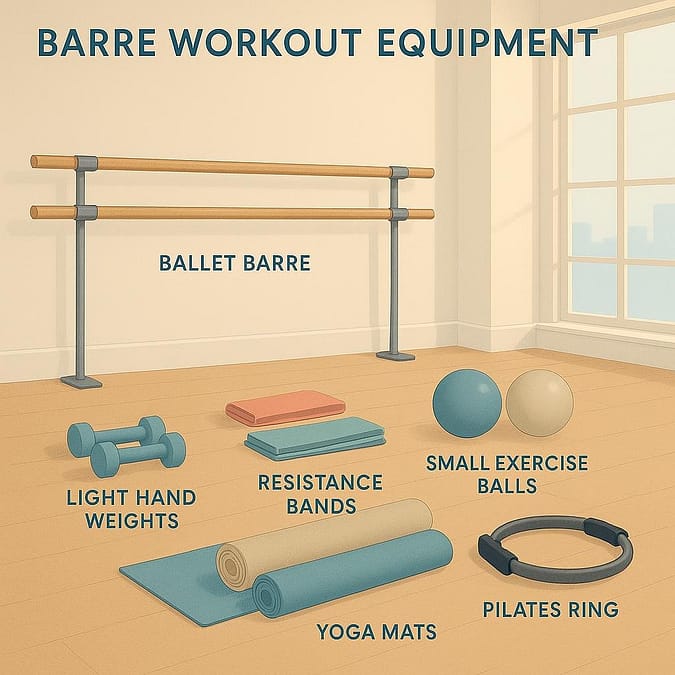
A typical class or session moves through a sequence: a warm-up, then targeted blocks working legs and glutes (often at the barre itself), core work, arms (usually with light hand weights, 1-3 lbs — the weight is intentionally light, since the volume of reps is what creates the challenge, not the load), and a stretch to close. Equipment is minimal: the barre itself, a mat, small weights, sometimes a resistance band or a small ball for added core engagement.
The core benefit: full-body toning through endurance, not load
Barre’s signature result — a “long and lean” look, in the marketing language — comes from high-rep, low-weight, isometric-heavy training, which builds muscular endurance and definition without significant size gain. It’s a genuinely full-body approach: most classes hit legs, glutes, core, and arms in a single session, rather than isolating one area the way a traditional strength split might.
Why it’s low-impact — and who that matters most for
Because barre movements are small, controlled, and rarely involve jumping or high-impact motion, it’s one of the more joint-friendly workout styles available. That makes it a strong option for people returning from injury (with a doctor’s clearance), older adults concerned about joint stress, anyone newer to exercise who wants to build a base without the impact of running or plyometric training, and people who simply want an effective workout that doesn’t leave their knees or hips aching the next day.
At-home vs. in-person
Barre translates reasonably well to at-home training, since the equipment requirements are minimal — a chair or countertop can substitute for an actual barre for balance work, and the light weights are easy to have on hand. The tradeoff is the same one that shows up across most fitness styles: an instructor watching your form catches the small technical errors (hip alignment, whether you’re actually finding the isometric hold or just going through the motion) that are easy to miss watching yourself in a mirror or a video. For a style this dependent on small positional details, that kind of real-time correction matters more than it does in, say, a straightforward strength-training session.
Starting as a beginner
The shake is normal — if your legs are trembling by the end of a set, that’s the isometric work doing exactly what it’s supposed to, not a sign you’re out of shape. Modifications exist for nearly every position (reducing range of motion, using the barre for more support, dropping the light weights entirely) and a good instructor will offer them without being asked. Expect soreness in places you don’t usually feel it — inner thighs, the small stabilizer muscles around the hips — even if you’re otherwise fit, since barre targets muscles differently than most other training styles.
Where this fits with a broader training plan
Barre works well as one piece of a larger program rather than the only thing you do — pairing it with strength training covers the load-bearing, bone-density, and larger-muscle-growth benefits that high-rep isometric work alone doesn’t fully provide. If you’re working with a trainer, barre-style blocks can be built directly into your regular sessions rather than treated as a separate class you have to fit in elsewhere.
Type A Training builds barre-style work into in-home sessions where it fits your goals — no separate class to schedule, no generic sequence, just the parts of barre that make sense for your body worked into a program a trainer is already running for you. Book a free consultation to talk through what that could look like.
Private yoga and Pilates sessions at home — matched to a certified instructor and built around your goals.
See yoga & pilates