What a Corrective Exercise Specialist Does: Assessment, Programs and Who It Helps
“Corrective exercise” sounds like physical therapy with a different name, and that confusion is exactly why it’s worth explaining clearly. It’s not rehab, and it’s not just regular personal training either. This covers what a Corrective Exercise Specialist actually is, what the certification requires, how the process works, the most common muscle imbalances it addresses, how it differs from physical therapy, and how athletes use it.
The short version
- A Corrective Exercise Specialist (CES) is a trainer with extra training in assessing how you move and fixing problem patterns.
- The process is assess, correct, then integrate: find the compensation, fix the cause, and build it back into real training.
- It helps with the kind of nagging tightness, imbalance and discomfort that builds up over years, not acute injuries.
- It is not physical therapy. Injuries, post-surgical recovery and new pain need a medical evaluation first.
- Athletes use it to clean up sport-specific imbalances and as part of injury prevention warm-ups.
What a Corrective Exercise Specialist actually is
A Corrective Exercise Specialist (CES) is a trainer with additional, specialized certification in identifying and addressing movement dysfunction: imbalances, compensations and restrictions that develop from posture, repetitive strain, old injuries, or simply years of the same movement patterns (a desk job, a favored side, a sport that overuses certain muscles). One of the most widely recognized credentials is the NASM-CES, which goes well beyond standard personal trainer certification. It requires a solid foundation in how the body is supposed to move, formal training in assessment protocols, and a structured system (assess, then correct, then integrate the correction back into normal training) rather than just a library of exercises.
The distinction that matters most: a general trainer helps you get stronger and fitter within however your body currently moves. A CES looks at how your body moves first, and treats that as something to actively improve, not just work around.
How the process actually works
It starts with an assessment, not a workout. A proper movement screen looks at how you stand, squat, reach and move through basic patterns, watching for the small compensations that don’t show up unless someone’s specifically looking for them: one shoulder riding higher than the other, a knee that tracks inward on a squat, hips that don’t rotate evenly. From there, a program gets built around what the assessment actually found: calming down overactive muscles that are compensating, activating underactive ones that have gone quiet, and retraining the pattern as a whole, not just stretching whatever feels tight and calling it done.
The integration step is the one people skip when they try to do this themselves. It’s not enough to fix a movement pattern in isolation; it has to get folded back into real training and real life, or the old compensation just creeps back in.

The steps of a corrective exercise program
- Health history and clearance. Past injuries, surgeries, pain and goals come first. Anything that needs a medical evaluation gets one before training starts.
- Movement assessment. Posture, an overhead squat, single-leg movements, range of motion and sometimes video, to see how you actually move.
- Prioritize. Pick the one to three findings that matter most for your pain and your goals, rather than chasing every small asymmetry.
- Inhibit and lengthen. Foam rolling and targeted stretching to calm down and lengthen overactive, tight muscles.
- Activate. Focused strengthening for the underactive muscles that should be doing more of the work.
- Integrate. Full-body movements that train the new pattern under real-world conditions.
- Reassess. Repeat the assessment every few weeks, then adjust the program based on what has changed.
NASM calls the four phases in steps 4 through 6 (inhibit, lengthen, activate, integrate) the Corrective Exercise Continuum. In practice, they usually fit into the warm-up and early part of a normal training session rather than replacing it.
Tools of the trade
The equipment is deliberately simple: foam rollers and massage tools for self-myofascial release, resistance bands for both activation work and assessment, balance and stability tools (a wobble board, a single-leg stance) to test and retrain control, and sometimes video or photo assessment to actually show someone the asymmetry they can feel but can’t quite see in a mirror. None of it requires a facility, which is exactly why this kind of work translates well to in-home training.
Common muscle imbalances
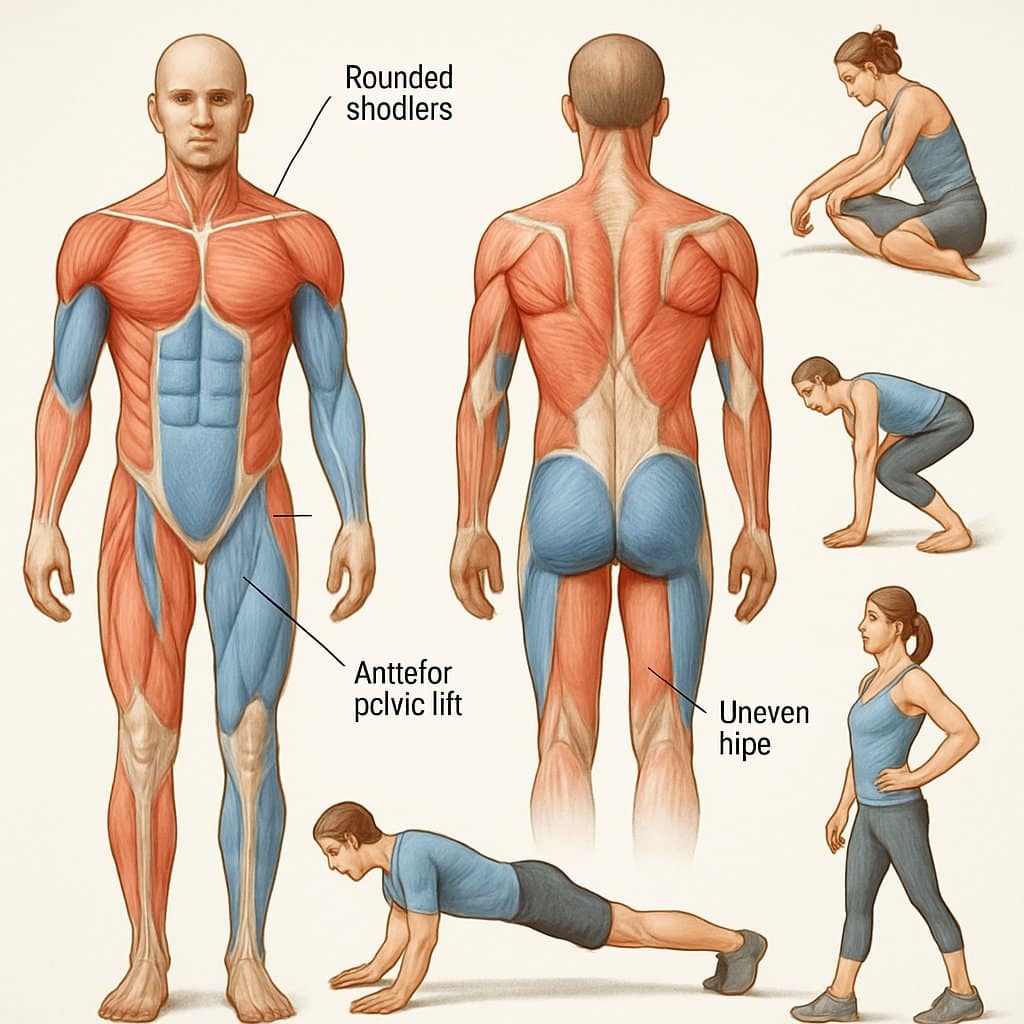
These are the patterns a corrective exercise assessment most often turns up. Each one has a typical cause and a typical focus, though the right program always depends on what your own assessment shows.
| Pattern | What it looks like | Often linked to | Common focus |
|---|---|---|---|
| Rounded shoulders and forward head | Shoulders roll forward and the head juts ahead of the body | Long hours at a desk or on a phone | Stretch the chest, strengthen the upper back and deep neck muscles |
| Anterior pelvic tilt | An exaggerated arch in the lower back with the pelvis tipped forward | Long periods of sitting, tight hip flexors, weak glutes and core | Stretch the hip flexors, strengthen the glutes and abdominals |
| Knees caving in | Knees drift inward during squats, lunges or landing | Weak hip muscles, limited ankle mobility | Strengthen the hips, improve ankle mobility, practice control |
| Feet rolling in | Arches collapse and ankles roll inward when standing or walking | Natural foot shape such as flat feet, weak foot and hip muscles, old foot or ankle injuries | Strengthen the feet and hips, check footwear |
| Side-to-side differences | One hip or shoulder tighter, weaker or higher than the other | A favored side, one-sided sports, old injuries | Single-arm and single-leg work to even things out |
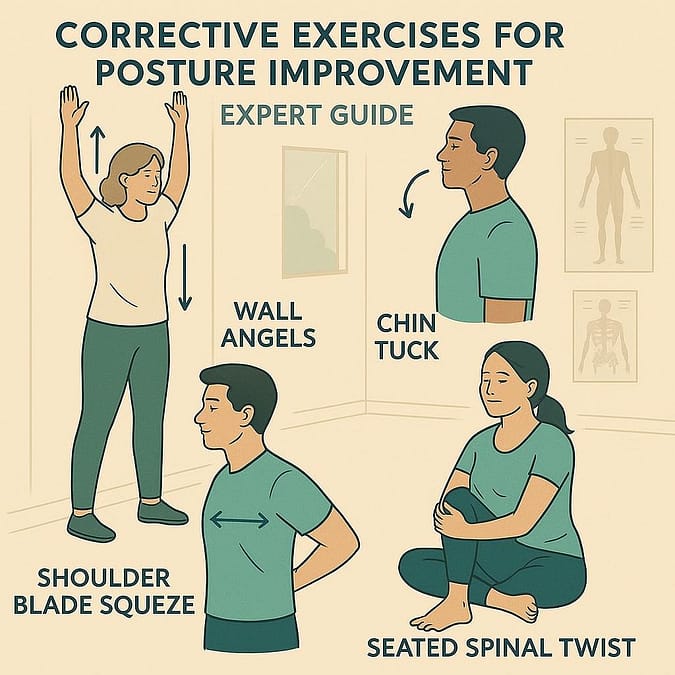
Worth keeping in perspective: everyone has small asymmetries, most people have some forward pelvic tilt, and research shows posture alone is a weaker predictor of pain than people often assume. The goal isn’t a perfectly symmetrical body. It’s movement that feels comfortable and stays strong for what you actually do. For more on desk posture, see our guide to corrective exercises for posture and our post on fixing rounded shoulders.
What this actually helps with
Corrective exercise commonly addresses the kind of movement issues that build up gradually rather than happen all at once: the rounded-shoulder, forward-head posture that comes from years at a desk; one hip or shoulder that’s chronically tighter than the other; low back tightness that’s actually a hip mobility problem wearing a disguise; knee tracking issues that trace back to weak hip stabilizers rather than the knee itself. These are the kinds of things that don’t show up as an acute injury. They show up as nagging discomfort, or as a plateau nobody can quite explain, or as pain that a doctor has cleared as “nothing structurally wrong” but that clearly isn’t nothing.
Worth being direct about the boundary here: corrective exercise isn’t a substitute for medical care. Acute pain, anything post-surgical, or an injury a doctor hasn’t yet evaluated needs medical clearance first. Corrective exercise picks up from there, working alongside a doctor’s or physical therapist’s guidance rather than instead of it.
Corrective exercise vs. physical therapy
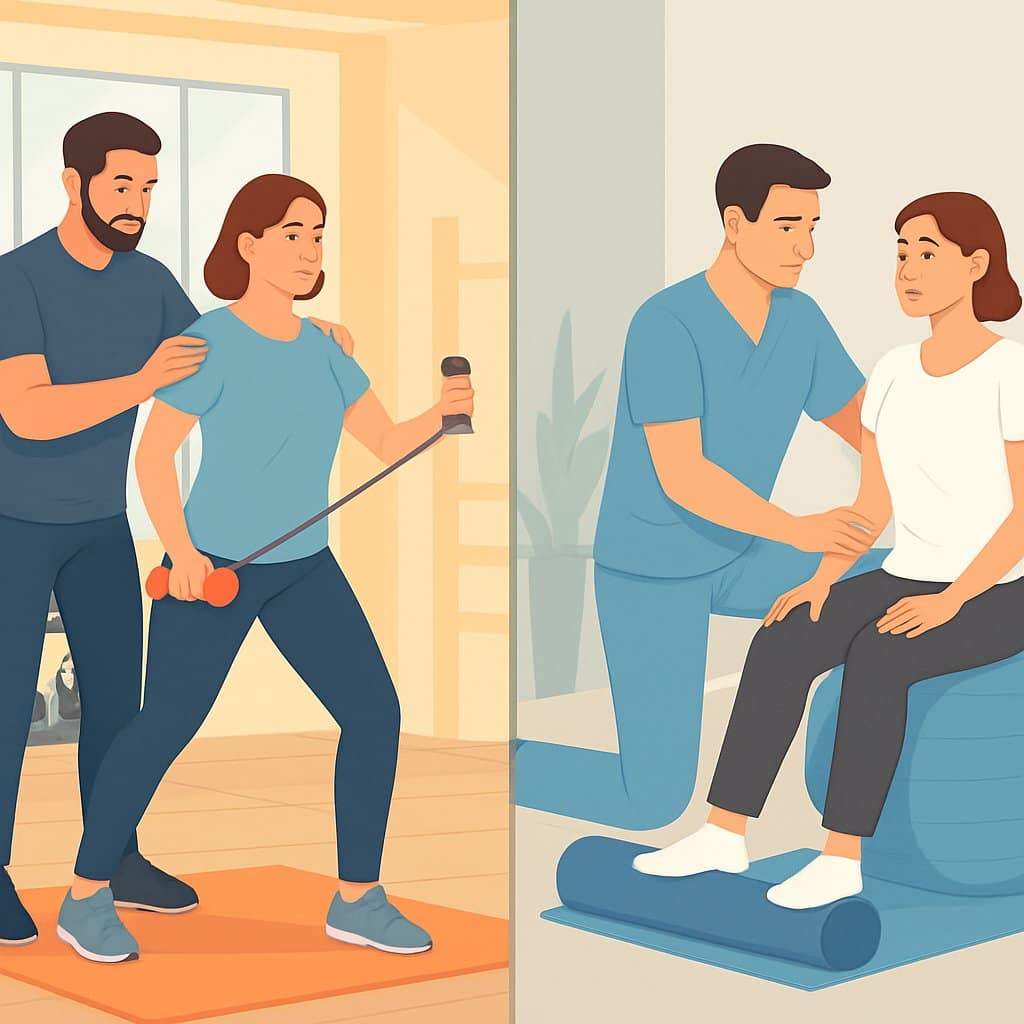
The two overlap, since both use exercise to improve how you move, but they are different professions with different roles.
| Corrective Exercise Specialist | Physical therapist | |
|---|---|---|
| Training | A specialist certification, usually added on top of a personal training certification | Today, a doctoral degree (DPT), plus a state license |
| Diagnosis | Does not diagnose or treat medical conditions | Evaluates and treats injuries and medical conditions |
| Best for | People cleared for exercise with nagging tightness, imbalances or movement habits to fix | Injuries, post-surgical recovery, new or severe pain |
| Insurance | Usually paid out of pocket | Often covered by health insurance |
| Where | Your home, a gym or a park, often as part of regular training | Usually a clinic or hospital |
They work well in sequence. A physical therapist handles the injury, and once you are discharged, a corrective exercise specialist can help you keep building strength and good movement so the problem is less likely to come back.
Corrective exercise for athletes
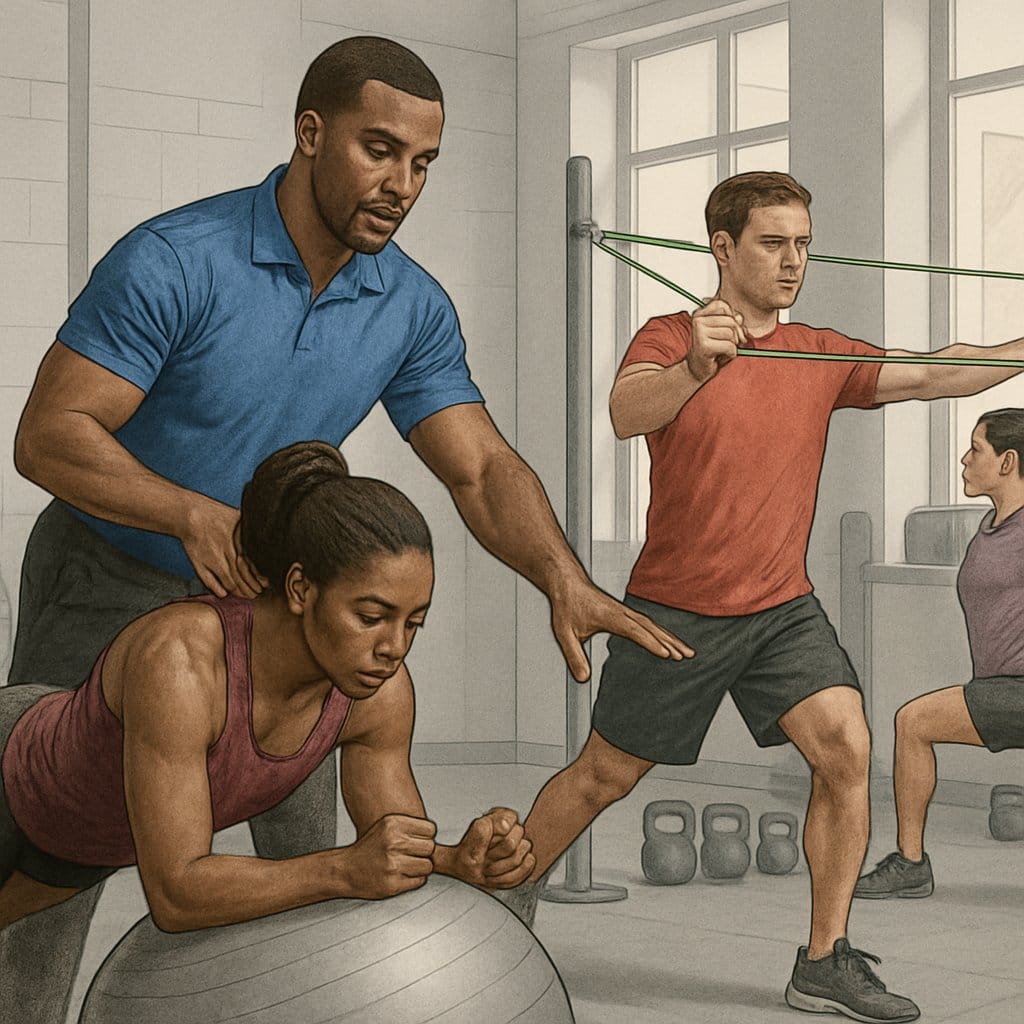
Sports tend to build their own imbalances. Overhead athletes such as tennis players and swimmers often develop tight, overworked shoulders; runners often need stronger hips to control their knees; golfers and other rotational athletes can end up stronger turning one way than the other. Corrective exercise helps athletes:
- Balance out what their sport overdevelops, with targeted work for the opposite side or the underused muscles.
- Warm up smarter. Structured warm-up programs that include strength, balance and landing drills, such as the FIFA 11+ program for soccer, have been shown to reduce injuries.
- Use the off-season well, when there is time to fix movement problems before building back up.
- Return from injury after a physical therapist has cleared them, rebuilding strength and confidence in the movements their sport demands.
Runners can also see our guide to good running form.
What working with a CES actually changes
The honest goal isn’t just “less tight.” It’s addressing the reason something is tight or weak in the first place, so it is more likely to stay fixed instead of needing to be stretched out again every single day. Someone who’s spent years compensating for a weak hip with their lower back often doesn’t realize how much unnecessary strain that’s created until the actual weak link gets addressed directly. The pattern shows up differently for everyone (a runner with a nagging IT band issue, someone whose shoulder keeps flaring up in the gym, someone who just wants to stop feeling like their hips are locked after a day at a desk), but the approach is the same: assess what’s actually happening, correct the specific cause, then build strength on a foundation that can actually hold it.
Where to start
If something’s been nagging at you for months without a clear cause (a tight hip, a shoulder that clicks, a lower back that never quite loosens up), a proper movement assessment is a better starting point than guessing at stretches from the internet. Type A’s corrective exercise training starts with exactly that kind of assessment, built into sessions with a certified specialist. A Type A Training trainer comes to your home, your building gym or a park in Manhattan and builds the program around what the assessment finds. See how corrective exercise training works or book a free consultation to get an actual assessment rather than another guess.
Frequently asked questions
What does a corrective exercise specialist do?
They assess how you move, find the imbalances and compensations behind nagging tightness or discomfort, and build a program to correct them and integrate the changes into your regular training.
Is corrective exercise the same as physical therapy?
No. Physical therapists are licensed clinicians who evaluate and treat injuries and medical conditions. Corrective exercise specialists are trainers who work with people already cleared for exercise. The two often work well one after the other.
Do I need a doctor’s clearance first?
If you have acute pain, a recent injury, recent surgery, numbness or tingling, or pain a doctor hasn’t evaluated, yes. The same goes for a heart, metabolic or kidney condition, or symptoms like chest pain or dizziness during exercise. For long-standing tightness or imbalances without those red flags, you can usually start with an assessment.
How long does corrective exercise take to work?
It varies with the problem and how consistent you are. Some people feel looser within a few sessions, while changing long-standing movement habits takes longer and depends on practicing the new patterns between sessions.
Can corrective exercise fix bad posture?
It can help a lot by strengthening the muscles that support good posture and stretching the ones that pull you out of it. Changing your daily habits, such as your desk setup and how often you move, matters too.
Is corrective exercise useful for athletes?
Yes. Athletes use it to balance out sport-specific imbalances, as part of injury prevention warm-ups, and to rebuild after an injury once they have been cleared.
Our corrective-exercise specialists rebuild posture and movement at home, assessment first, then a plan built for your body.
Meet our corrective specialists