What a Corrective Exercise Specialist Does
“Corrective exercise” sounds like physical therapy with a different name, and that confusion is exactly why it’s worth explaining clearly. It’s not rehab, and it’s not just regular personal training either. This covers what a Corrective Exercise Specialist actually is, what the certification requires, how the process works, and the kinds of issues this training is built to address.
What a Corrective Exercise Specialist actually is
A Corrective Exercise Specialist (CES) is a trainer with additional, specialized certification in identifying and addressing movement dysfunction — imbalances, compensations, and restrictions that develop from posture, repetitive strain, old injuries, or simply years of the same movement patterns (a desk job, a favored side, a sport that overuses certain muscles). The most widely recognized credential is the NASM-CES, which goes well beyond standard personal trainer certification: it requires a solid foundation in how the body is supposed to move, formal training in assessment protocols, and a structured system (assess, then correct, then integrate the correction back into normal training) rather than just a library of exercises.
The distinction that matters most: a general trainer helps you get stronger and fitter within however your body currently moves. A CES looks at how your body moves first, and treats that as something to actively improve, not just work around.
How the process actually works
It starts with an assessment, not a workout. A proper movement screen looks at how you stand, squat, reach, and move through basic patterns, watching for the small compensations that don’t show up unless someone’s specifically looking for them — one shoulder riding higher than the other, a knee that tracks inward on a squat, hips that don’t rotate evenly. From there, a program gets built around what the assessment actually found: inhibiting overactive muscles that are compensating, activating underactive ones that have gone quiet, and retraining the pattern as a whole — not just stretching whatever feels tight and calling it done.
The integration step is the one people skip when they try to do this themselves. It’s not enough to fix a movement pattern in isolation; it has to get folded back into real training and real life, or the old compensation just creeps back in within a few weeks.
Tools of the trade
The equipment is deliberately simple: foam rollers and massage tools for self-myofascial release, resistance bands for both activation work and assessment, balance and stability tools (a wobble board, a single-leg stance) to test and retrain control, and sometimes video or photo assessment to actually show someone the asymmetry they can feel but can’t quite see in a mirror. None of it requires a facility — which is exactly why this kind of work translates well to in-home training.
What this actually helps with
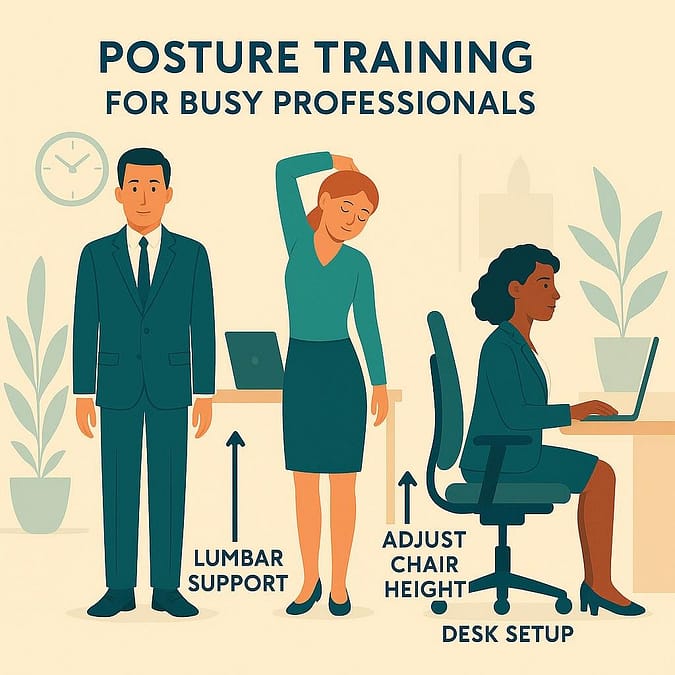
Corrective exercise commonly addresses the kind of movement issues that build up gradually rather than happen all at once: the rounded-shoulder, forward-head posture that comes from years at a desk; one hip or shoulder that’s chronically tighter than the other; low back tightness that’s actually a hip mobility problem wearing a disguise; knee tracking issues that trace back to weak hip stabilizers rather than the knee itself. These are the kinds of things that don’t show up as an acute injury — they show up as nagging discomfort, or as a plateau nobody can quite explain, or as pain that a doctor has cleared as “nothing structurally wrong” but that clearly isn’t nothing.
Worth being direct about the boundary here: corrective exercise isn’t a substitute for medical care. Acute pain, anything post-surgical, or an injury a doctor hasn’t yet evaluated needs medical clearance first — corrective exercise picks up from there, working alongside a doctor’s or physical therapist’s guidance rather than instead of it.
What working with a CES actually changes
The honest goal isn’t just “less tight” — it’s addressing the reason something is tight or weak in the first place, so it stays fixed instead of needing to be stretched out again every single day. Someone who’s spent years compensating for a weak hip with their lower back often doesn’t realize how much unnecessary strain that’s created until the actual weak link gets addressed directly. The pattern shows up differently for everyone — a runner with a nagging IT band issue, someone whose shoulder impingement keeps flaring up in the gym, someone who just wants to stop feeling like their hips are locked after a day at a desk — but the approach is the same: assess what’s actually happening, correct the specific cause, then build strength on a foundation that can actually hold it.
Where to start
If something’s been nagging at you for months without a clear cause — a tight hip, a shoulder that clicks, a lower back that never quite loosens up — a proper movement assessment is a better starting point than guessing at stretches online. Type A’s corrective exercise training starts with exactly that kind of assessment, built into in-home sessions with a certified specialist. See how corrective exercise training works or book a free consultation to get an actual assessment rather than another guess.
Our corrective-exercise specialists rebuild posture and movement at home — assessment first, then a plan built for your body.
Meet our corrective specialists