Progressive Walking Plan: Sedentary to 5 Miles in 8 Weeks
Walking is one of the easiest ways to get fit from a standing start. It needs no gym and no special skill, it is gentle on your joints, and it pays off for your heart, blood sugar, weight, mood and brain. This guide’s 8-week plan builds you up gradually to a 5-mile walk. Taking longer is fine.
This guide gives you that 8-week plan, plus how fast to walk, good walking form, shoes, adding strength and intervals, how many steps you really need, walking after meals, walking for weight management, walking for your mind, recovery and safety.
The short version
- Start where you are: 10 to 20 minutes, 3 or 4 times a week, is a fine beginning.
- Build gradually, adding a little distance or time each week, and repeat a week whenever you need to.
- Aim for a brisk pace: you can talk but not sing.
- Work up to at least 150 minutes a week of brisk walking, plus 2 days of strength training.
- Good shoes, good posture and rest days help prevent injuries.
- Check with your doctor first if you have heart disease, diabetes, joint problems or symptoms such as chest pain or dizziness with activity.
Why walking works
Regular brisk walking is moderate-intensity aerobic activity, the kind the U.S. Physical Activity Guidelines recommend for at least 150 minutes a week. Walking regularly helps you:
- Lower your risk of heart disease, stroke and type 2 diabetes
- Manage blood pressure, cholesterol and blood sugar
- Manage your weight
- Help keep bones and muscles strong
- Improve your mood, sleep and energy
- Support thinking and memory as you age
Walking is also easy to fit into your day, cheap and low impact, which makes it easy to start and keep up.
Before you start
Most people can start a walking program safely. Talk to your doctor first if you have heart disease, high blood pressure, diabetes, joint or back problems, or if you have had chest pain, dizziness or unusual shortness of breath during activity.
Then find your starting point. Walk at a comfortable pace for 15 to 20 minutes and note:
- How far you went (a phone app or fitness tracker works)
- How hard it felt on a scale of 0 to 10
- How you felt afterward and the next day
If 15 minutes is a stretch, start with 5 or 10 minutes and build from there. Any amount of walking is better than none.
How fast should you walk?
For health benefits, aim for a brisk pace. Use the talk test: at a moderate, brisk pace you can talk but not sing. If you can only say a few words before pausing for breath, you are working at a vigorous level. On a 0 to 10 effort scale, where 0 is sitting and 10 is your hardest effort, a brisk walk should feel like about a 5 or 6.
A brisk pace is about 3 to 4 miles per hour for many adults, or roughly 15 to 20 minutes per mile. The CDC counts walking at 2.5 miles per hour or faster as brisk, so do not worry if you start slower. Your pace will improve as your fitness does.
The 8-week progressive walking plan
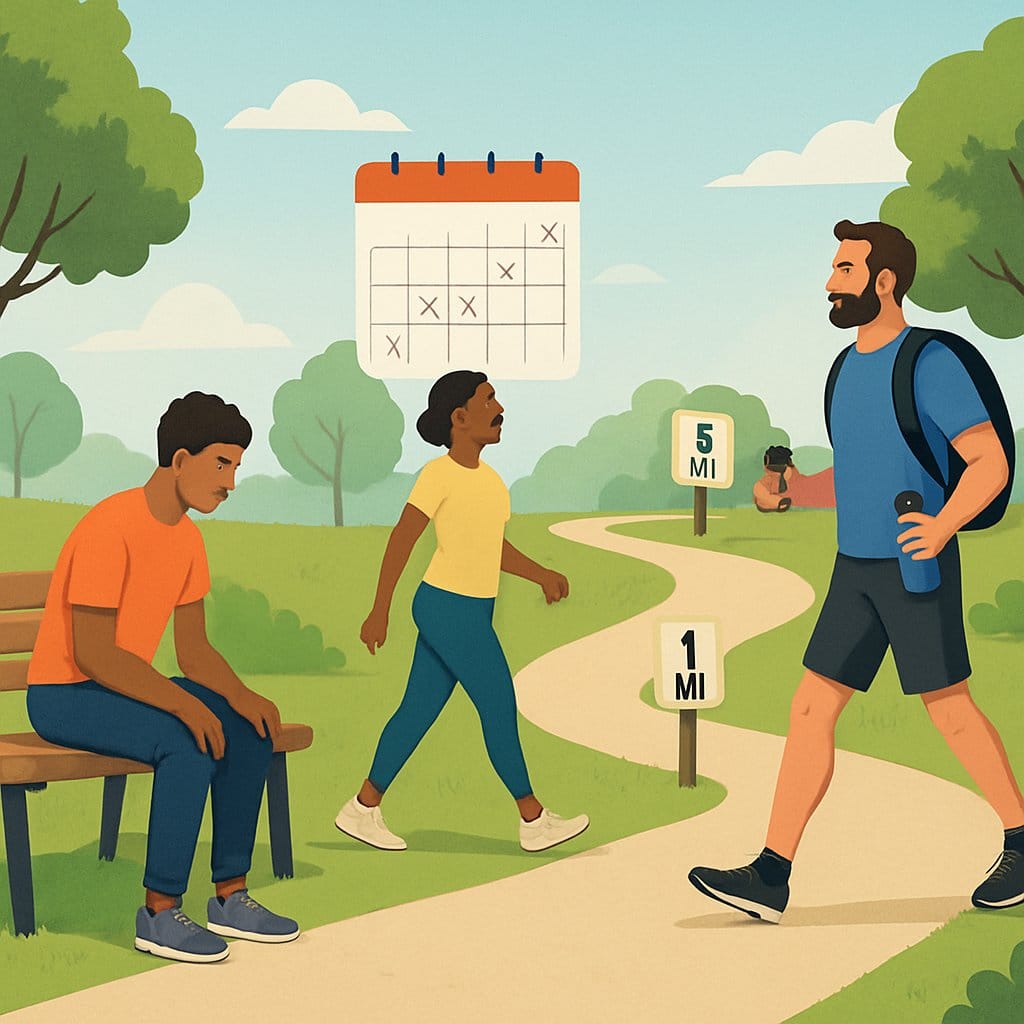
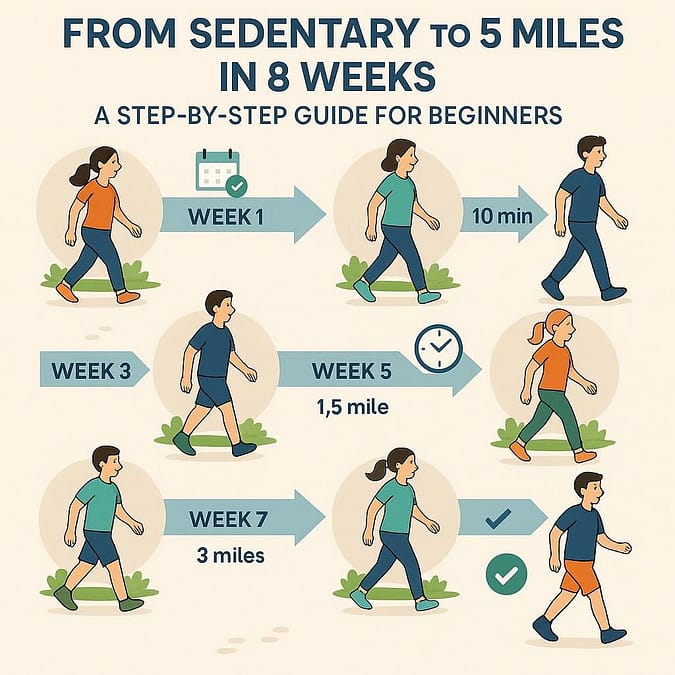
This plan takes you from a few short walks a week to a 5-mile walk by week 8. Each week adds a little distance, which is how fitness builds safely: a gradual increase in how long, how far or how hard you walk.
| Week | Walks | Distances | Weekly total | Focus |
|---|---|---|---|---|
| 1 | 3 to 4 | 0.5 to 1 mile each | 1.5 to 4 miles | Building the habit |
| 2 | 4 | Two 1-mile and two 0.75-mile walks | 3.5 miles | Good walking form |
| 3 | 4 | Two 1.25-mile and two 1-mile walks | 4.5 miles | Try short faster intervals |
| 4 | 4 to 5 | One 2-mile walk, the rest 1 mile | 5 to 6 miles | Check in on how you feel |
| 5 | 5 | One 2.5-mile walk, the rest 1 to 1.25 miles | 6.5 to 7.5 miles | Pick up the pace |
| 6 | 5 | One 3-mile walk, the rest 1.5 miles | About 9 miles | Add hills or new routes |
| 7 | 5 | One 4-mile walk, the rest 1.5 to 2 miles | 10 to 12 miles | Hold a steady brisk pace |
| 8 | 5 | One 5-mile walk, the rest 1.5 to 2 miles | 11 to 13 miles | Your 5-mile walk |
How to use it:
- Spread your walks out, with your longest walk on a day when you have more time.
- Watch the bigger jumps. Your longest walk grows the most in weeks 4 and 7. If either feels like a lot, repeat the week before.
- Repeat any week that felt hard. There is no prize for rushing, and taking 10 or 12 weeks is fine.
- Prefer minutes to miles? At a brisk pace, each mile takes about 15 to 20 minutes, so a 5-mile walk is roughly 75 to 100 minutes.
- Warm up and cool down with 3 to 5 minutes of easy walking at the start and end.
- Back off if pain lasts into the next day or gets worse each walk.
By weeks 7 and 8, you will be walking about 150 minutes a week or more, which meets the aerobic activity guidelines on its own.
Walking form
- Stand tall with your head up, looking forward rather than down at the ground or your phone.
- Keep your neck, shoulders and back relaxed.
- Let your arms swing naturally with a slight bend at the elbows. Bending them more and pumping them helps when you speed up.
- Keep your core lightly engaged and your back straight, without arching.
- Land on your heel and roll through to your toes.
- Take comfortable steps. To go faster, take quicker steps rather than longer ones.
For more on posture, see our posture guide, which includes a section on walking posture.
Shoes and gear
Comfortable, supportive shoes matter more than anything else you buy. Look for a good fit with room to wiggle your toes, a flexible sole and enough cushioning for the surfaces you walk on. Replace them when the soles or cushioning wear down. For details, see our guide to walking shoes.
Beyond shoes, wear moisture-wicking layers, carry water on longer walks, and use reflective gear or a light if you walk early or after dark.
Add strength to your walks
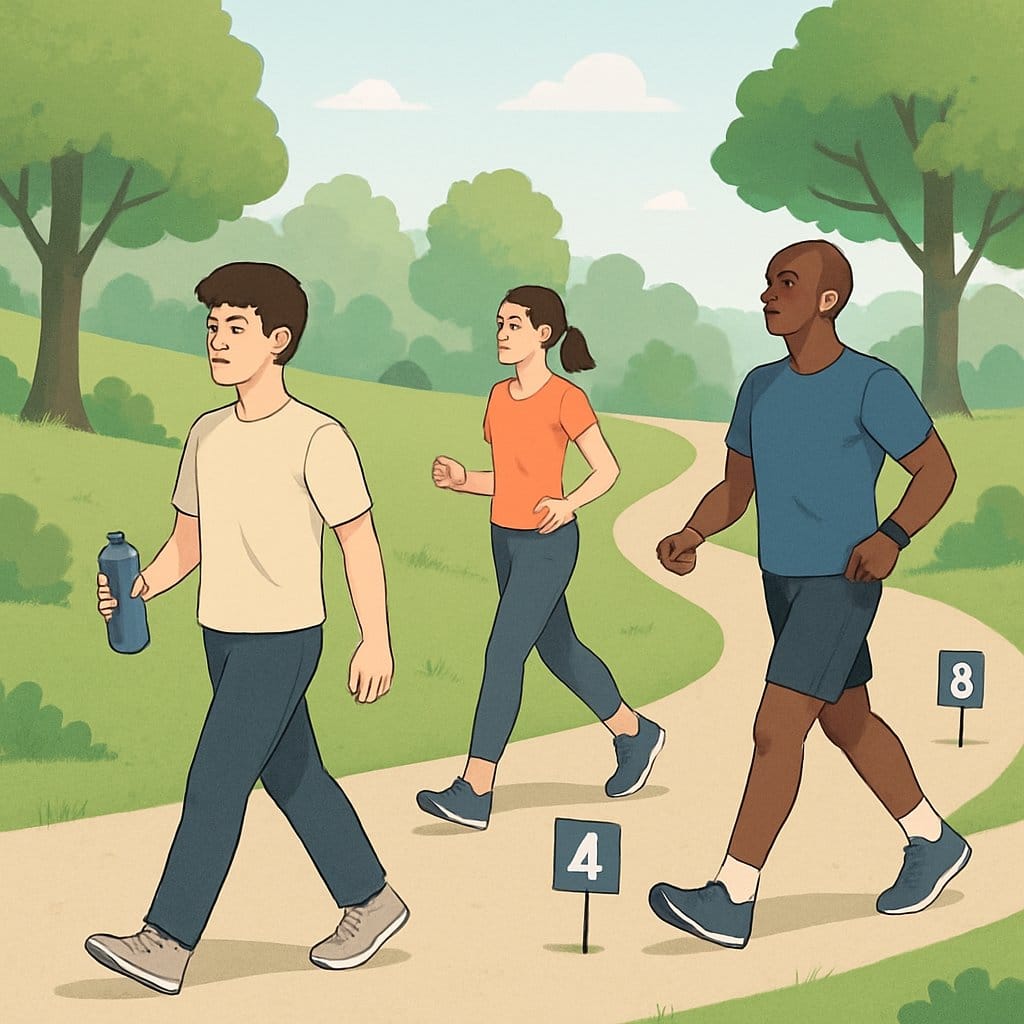
Walking builds aerobic fitness, but it does not replace strength training. The guidelines recommend muscle-strengthening activity for all major muscle groups at least 2 days a week. You can do it at home, or build it right into a walk with a simple circuit.
Walking strength circuit: walk briskly for 5 minutes, then stop at a bench or step and do one exercise. Repeat until you have done each move 2 or 3 times.
- Squats or sit-to-stands on a bench: 10 to 15
- Incline push-ups with your hands on a bench or railing: 8 to 12
- Step-ups on a low step or curb: 8 to 10 each leg
- Reverse lunges: 8 to 10 each leg
- Calf raises on a step: 15
Add a 30-second plank at home afterward for your core. For full workouts, see our guides to strength training for women over 50 and the best strength training exercises for seniors.
When walking gets easy: intervals, hills and plateaus
As you get fitter, the same walk will feel easier. That is progress, and it is also your cue to change something.
- Intervals: after warming up, alternate 30 to 60 seconds of fast walking with 1 to 2 minutes at your normal pace.
- Hills and stairs: add an incline route or a few flights of stairs.
- Longer walks: add 5 to 10 minutes to your longest walk.
- New routes: trails, parks and uneven ground work your muscles and balance differently.
- Arm work: pump your arms, or try walking poles.
Most of your walking can stay at a steady, conversational pace. Our guide to zone 2 cardio explains why that easier work builds your aerobic base.
How many steps do you need?
The famous 10,000 steps a day goal did not come from research. It is usually traced to a Japanese pedometer marketed in the 1960s. Since then, large studies have looked at step counts and health.
A 2022 analysis of 15 studies found that the risk of early death kept dropping as daily steps rose, then leveled off at about 6,000 to 8,000 steps a day for adults 60 and older, and about 8,000 to 10,000 for younger adults. In short: more steps are better up to a point, and 10,000 is a reasonable target but not a magic number. If you take 3,000 steps a day now, adding 1,000 to 2,000 is a meaningful first goal.
Walking after meals
A short walk after eating helps your muscles use the sugar from your meal, which can blunt the rise in blood sugar that follows. A 10 to 15 minute walk after meals is an easy habit to build. If you sit for long stretches, getting up for a few minutes of easy walking every half hour also helps.
If you have diabetes: walking is highly recommended, but talk to your doctor about timing and blood sugar checks, especially if you take insulin or medicines that can cause low blood sugar. Carry a fast-acting sugar source, wear well-fitting shoes and socks, and check your feet for blisters or sores after walks.
Walking for weight management
Walking burns calories, and the amount grows with your weight, pace and distance. It works best for weight management when it is part of a bigger picture:
- Walk most days, and build toward more than 150 minutes a week if weight loss is your goal.
- Pair walking with strength training to protect muscle.
- Pay attention to what and how much you eat. It is easy to eat back the calories a walk burns.
- Add daily steps outside your workouts: stairs, walking calls, getting off the bus a stop early.
Walking for your mind and mood
Regular walking can lift your mood, ease stress and anxiety, and help you sleep better. Over time, physical activity also supports thinking and memory as you age. A few ways to get more from it:
- Walk in green spaces. Many people find walks in parks and along water more restorative than walks on busy streets.
- Try walking meditation. Walk slowly, notice the feeling of each step, your breath and the sights and sounds around you. When your mind wanders, gently bring it back to your steps.
- Walk with others. A walking partner or group makes walks more enjoyable and helps you show up on days you would rather not.
Morning or evening?
The best time to walk is the time you will stick with. Morning walks can be easier to protect from a busy schedule, while evening walks fit well after dinner. For the pros and cons of each, see morning vs. evening walks.
Recovery and injury prevention
- Build gradually. Doing too much too soon is a common cause of aches and overuse injuries.
- Take easy days. A short, relaxed walk makes a good active recovery day between harder sessions.
- Stretch gently after walks: calves, hamstrings, quads and hip flexors.
- Watch for warning signs: pain that lasts more than a day, gets worse each walk, or comes with swelling. Rest, and see a doctor or physical therapist if it does not improve.
- Stop and get help for chest pain, dizziness, unusual shortness of breath or an irregular heartbeat.
Walking safely
- Drink water before and after walks, and carry it on long or hot walks.
- In hot weather, walk early or late in the day and slow down. In cold weather, dress in layers.
- Be visible after dark, and keep the volume low or one earbud out so you can hear traffic.
- Choose well-lit, familiar routes, and let someone know where you are going on longer walks.
Beyond 5 miles
Once you can walk 5 miles comfortably, keep it interesting:
- Sign up for a charity walk or a local 5K.
- Add more hills, trails or longer weekend walks.
- Try mixing in short jogs. Our run-walk method guide shows how.
- Keep 2 strength sessions a week in your routine.
Working with a trainer
A trainer can check your walking form, build the strength that keeps your knees, hips and back happy, and adjust your plan as you progress. A Type A Training trainer comes to your home or building gym in Manhattan, or meets you outdoors, such as in a park, and builds a program around your walking goals, whether that is your first 5-mile walk, weight loss or staying strong as you age.
Frequently asked questions
How long does it take to walk 5 miles?
At a brisk pace of 15 to 20 minutes per mile, about 75 to 100 minutes. Beginners may take longer, and that is fine.
Can a beginner really walk 5 miles in 8 weeks?
The plan above is built to get you there by building up gradually. If a week feels too hard, repeat it. Reaching 5 miles in 10 or 12 weeks is still a big win.
Is walking enough exercise?
Brisk walking can meet the aerobic activity guidelines on its own. For complete fitness, add strength training at least 2 days a week, and some balance and flexibility work.
How many steps a day should I aim for?
Studies suggest the benefits for longevity level off at about 6,000 to 8,000 steps a day for adults 60 and older and about 8,000 to 10,000 for younger adults. If you are well below that, add 1,000 to 2,000 steps a day as a first goal.
Should I walk every day?
Walking daily is safe for most people, as long as you build up gradually and keep some walks easy. If you feel run down or sore, take an easier day.
Is it better to walk faster or longer?
Both help. Most of your walking should be at a brisk, comfortable pace, with occasional faster intervals or hills once you have a base. Building total time is the first priority for beginners.
Can walking help me lose weight?
Yes, especially when you walk most days, combine it with strength training and pay attention to your eating. Walking alone without changes to diet usually leads to modest weight loss.
Is walking good for people with diabetes?
Yes. Walking helps your body use blood sugar, and a short walk after meals can help limit blood sugar rises. Check with your doctor about timing and blood sugar monitoring, and take good care of your feet.
Work with a certified trainer who comes to you: home, building gym, or park. Matched to your goals, not just whoever’s available.
Get matched with a trainer