Corrective Exercises for Posture Improvement: A Complete Guide
Good posture is not about standing like a soldier all day. It is about having the strength and mobility to hold your body in a comfortable, balanced position, and the habit of changing position often. Posture problems are often linked to long hours of sitting, screens and a few weak or tight muscle groups, and many improve with simple corrective exercises and a better daily setup.
This guide covers what good posture looks like, the most common posture problems, a quick self-check, the best corrective exercises, a 10-minute posture workout, desk setup, tech neck, walking posture, posture tools, posture as you age, and when to get help.
The short version
- There is no single perfect posture. Changing position often matters as much as how you sit or stand.
- The most common problems are forward head posture (tech neck), rounded shoulders, a rounded upper back and an exaggerated arch in the lower back.
- Strengthen the upper back, glutes, core and deep neck muscles, and stretch the chest and hip flexors.
- Set up your desk so the top of the screen is at or slightly below eye level and about an arm’s length away, and get up at least every 30 minutes.
- Posture braces can remind you to sit up, but they do not build the muscles that hold good posture.
- See a doctor or physical therapist for numbness, tingling, pain that keeps getting worse, or a curve in your back that is new or changing.
What good posture looks like
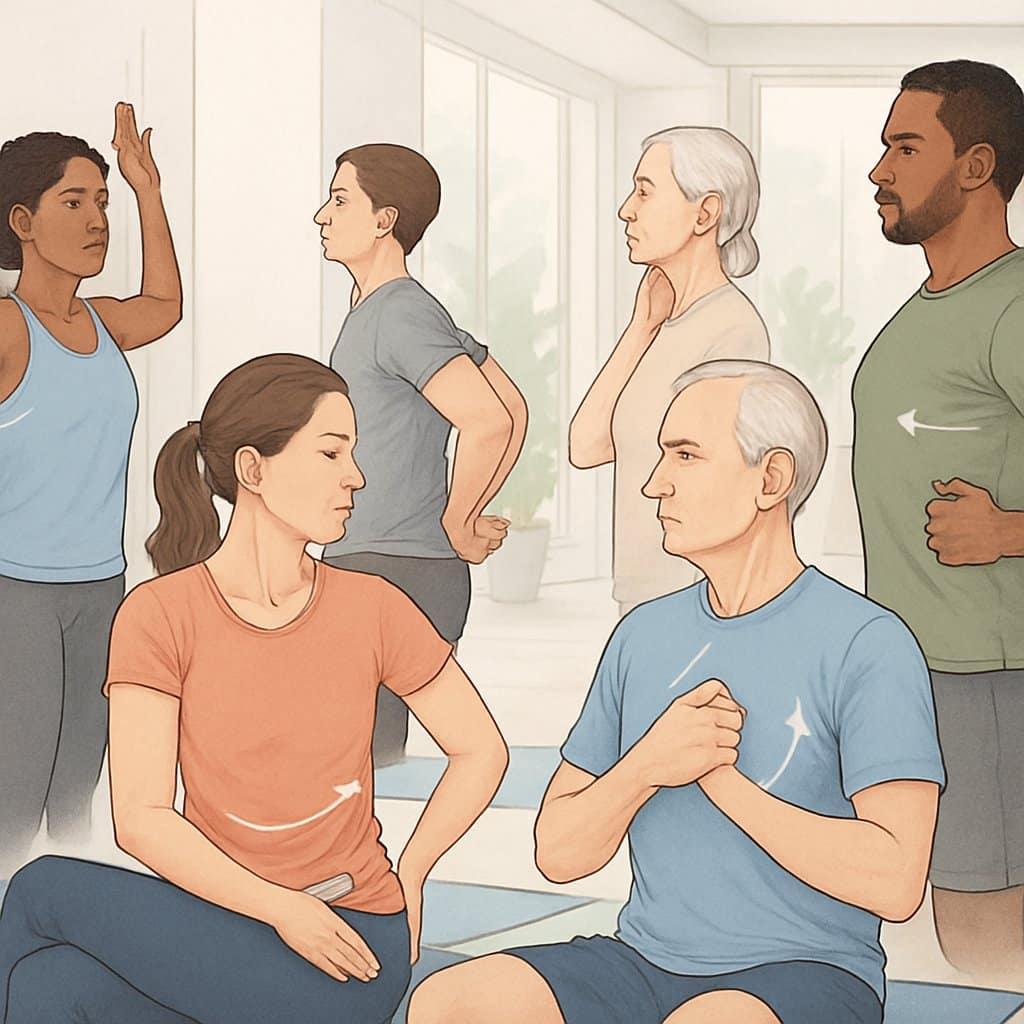
Seen from the side, good standing posture lines up your ear, shoulder, hip, knee and ankle in a roughly straight vertical line. Your spine keeps its natural curves: a gentle inward curve at the neck, a gentle outward curve in the upper back and a gentle inward curve in the lower back.
- Head: ears over your shoulders, chin level, not poking forward.
- Shoulders: relaxed and level, not rolled forward or hiked up toward your ears.
- Upper back: a natural slight curve, not slumped.
- Pelvis: neutral, not tipped far forward (a big arch) or tucked under (a flat back).
- Feet: weight spread evenly across both feet.
Sitting follows the same idea: feet flat on the floor, your back supported, shoulders relaxed and your head stacked over your shoulders.
One important point: research has not found one “correct” posture that prevents pain. People are comfortable in a range of positions. Staying in any one position for hours tends to leave you stiff and sore. Moving often and building strength both help. The best posture is often your next posture.
Common posture problems
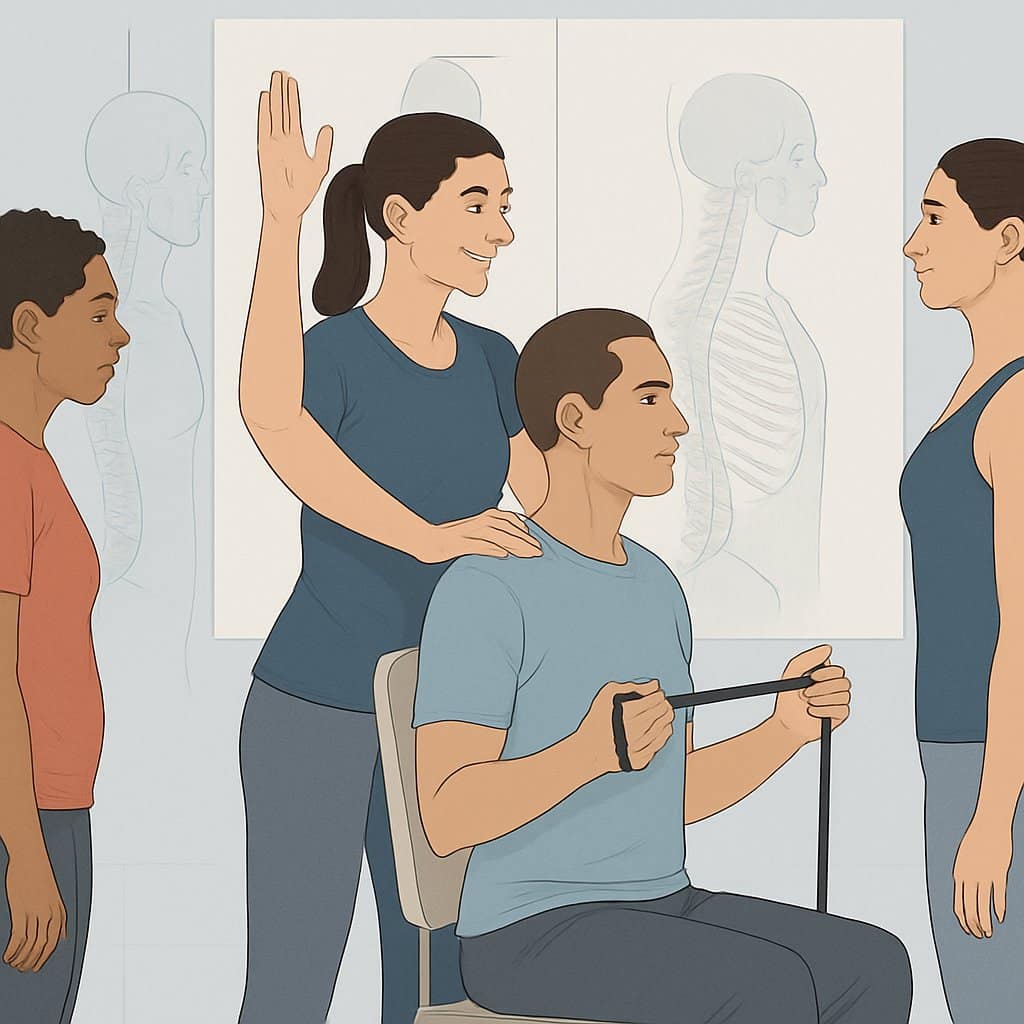
Posture problems are often linked to muscle imbalances: some muscles get tight from spending hours in one position, while the muscles that help hold you upright get weak from not being used.
| Problem | What it looks like | Often tight | Often weak | Start with |
|---|---|---|---|---|
| Forward head posture (tech neck) | Head juts out in front of the shoulders, chin pokes forward | Back of the neck, upper traps | Deep neck flexors, upper back | Chin tucks, rows, wall angels |
| Rounded shoulders | Shoulders roll forward, palms face behind you when your arms hang | Chest, front of the shoulders | Upper back, muscles between the shoulder blades | Doorway chest stretch, band pull-aparts, rows |
| Rounded upper back | Slumped, hunched upper back | Chest | Upper back extensors | Foam roller thoracic extension, prone Y raises |
| Anterior pelvic tilt | Big arch in the lower back, belly and backside push out | Hip flexors, lower back | Glutes, deep core | Hip flexor stretch, glute bridges, dead bugs |
| Flat back or tucked pelvis | Lower back looks flat, hips tucked under | Hamstrings | Hip flexors, lower back | Hamstring stretch, bird dogs |
These often show up together. Forward head posture and rounded shoulders, for example, usually travel as a pair after years of desk work. For a deeper look at one of the most common patterns, see our guide to fixing rounded shoulders.
Check your posture in two minutes
These quick checks will not diagnose anything, but they show you where to focus.
- The wall test: stand with your heels a few inches from a wall and your backside, shoulder blades and the back of your head touching it. If your head cannot touch the wall without tilting your chin up, your head likely sits forward. Slide a hand behind your lower back: about a hand’s thickness of space is typical. A lot more space suggests a big arch; almost none suggests a flat back.
- The side photo: have someone take a photo of you from the side while you stand normally. Check whether your ear lines up over your shoulder and your shoulder over your hip.
- The arm hang: stand relaxed and look down at your hands. If your knuckles face forward, your shoulders may be rolling in. Relaxed hands usually face your thighs.
- The mirror check: face a mirror and look at your shoulders and hips. Are they level? Is your head tilted to one side?
Repeat the photo every few weeks to see your progress.
What causes poor posture
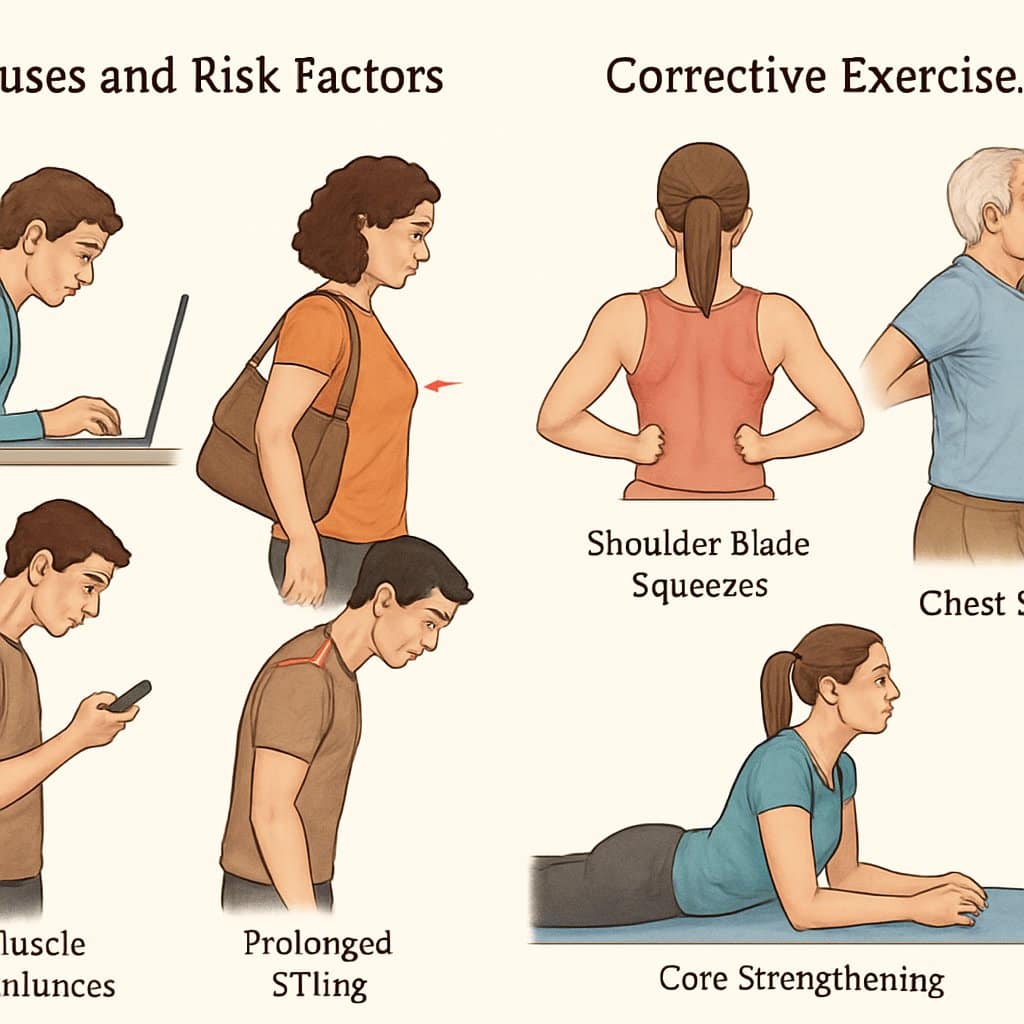
- Long hours of sitting: hip flexors can get stiff, glutes get little use and the upper back tends to slump.
- Screens and phones: looking down at a phone or a low laptop pulls the head forward for hours a day.
- A poor workstation: a monitor that is too low or too far away, a chair at the wrong height or no lower back support.
- Muscle weakness: a weak upper back, glutes and core make it hard to hold good posture, even when you try.
- Daily habits: carrying a heavy bag on one shoulder, working from the couch or bed, and long commutes looking down at a phone.
- Stress and fatigue: tension can pull the shoulders up and forward, and tired muscles let you slump.
- Age and bone health: loss of muscle and, for some people, bone loss can increase rounding of the upper back over time.
The best corrective exercises for posture
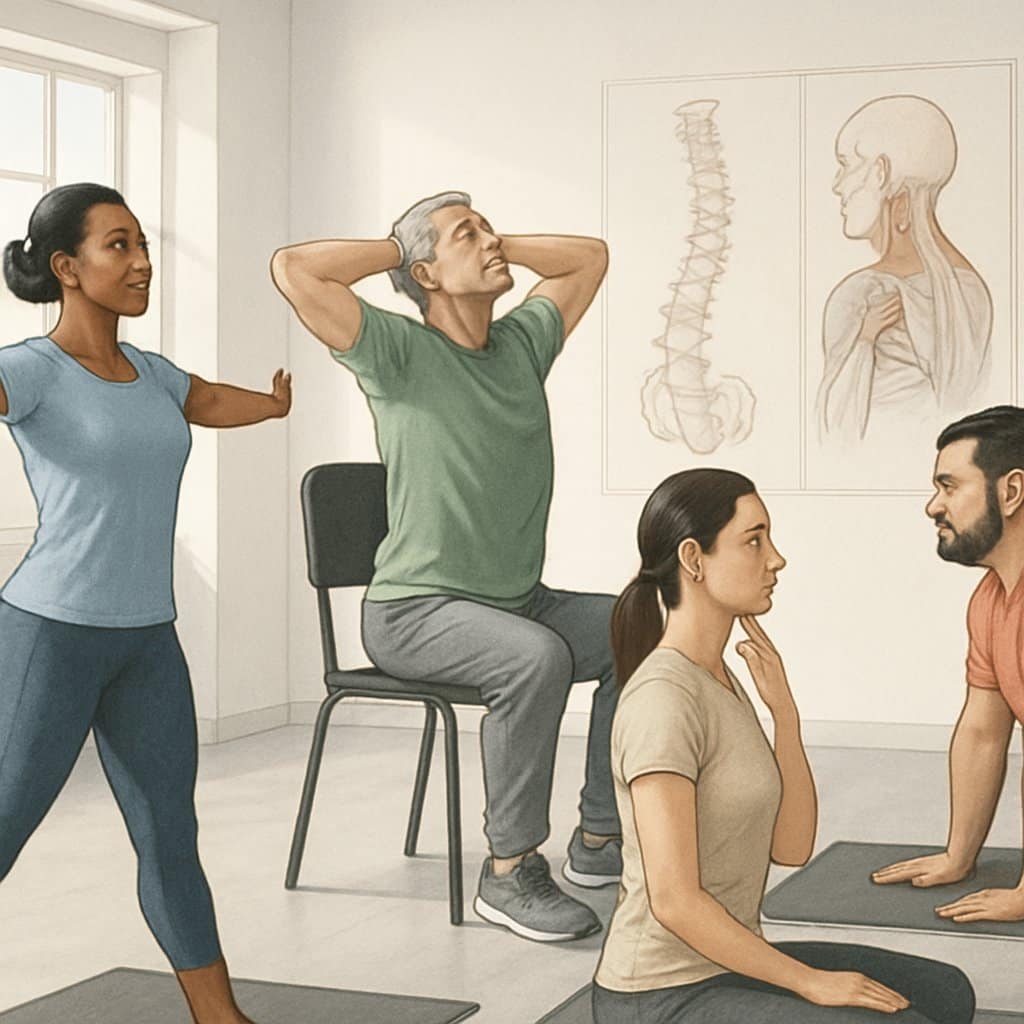
Good corrective work does two things: it stretches what is tight and strengthens what is weak. Focus on the upper back, the muscles between your shoulder blades, your glutes, your core and the deep muscles at the front of your neck.
| Exercise | What it helps | How to do it | Sets and reps |
|---|---|---|---|
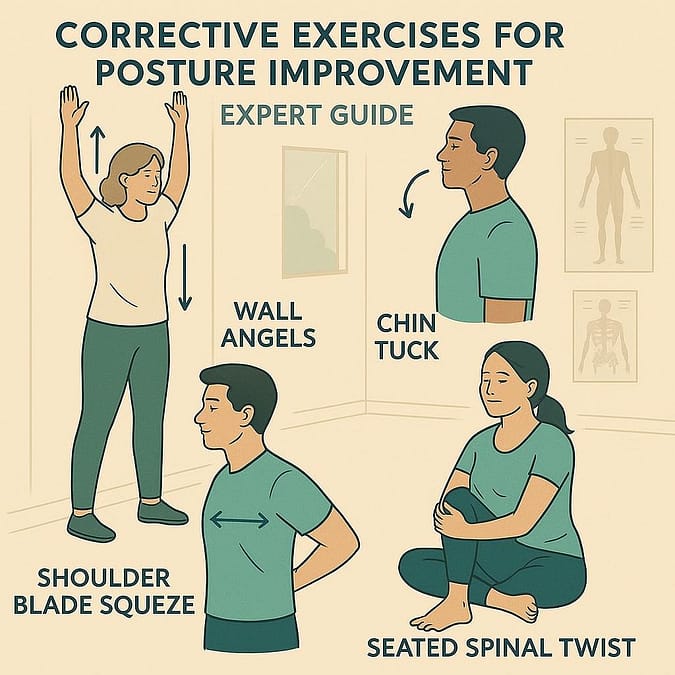
| Chin tucks | Forward head posture | Sit or stand tall. Glide your chin straight back, as if making a double chin, without tilting your head down. Hold, then release. | 10 reps, 3 to 5 second hold |
| Wall angels | Rounded shoulders, upper back | Stand with your back against a wall, arms in a goalpost shape. Slide your arms up and down while keeping your back and arms as close to the wall as you comfortably can. | 2 sets of 10 |
| Band pull-aparts | Rounded shoulders | Hold a light resistance band at shoulder height with straight arms. Pull it apart by squeezing your shoulder blades together, then return slowly. | 2 sets of 15 |
| Rows | Upper back strength | With a band, cable or dumbbell, pull your elbows back toward your ribs and squeeze your shoulder blades together. | 3 sets of 10 to 12 |
| Prone Y raises | Upper back, lower traps | Lie face down with arms overhead in a Y. Lift your arms a few inches by drawing your shoulder blades down and back. | 2 sets of 8 to 10 |
| Doorway chest stretch | Tight chest, rounded shoulders | Place your forearms on either side of a doorway and step through gently until you feel a stretch across your chest. | 2 to 3 holds of 30 seconds |
| Foam roller thoracic extension | Stiff, rounded upper back | Lie with a foam roller across your upper back, hands behind your head. Gently extend over the roller, then move it a few inches and repeat. Keep the roller under your upper back, not your lower back or neck, and support your head without pulling it forward. | 5 to 8 slow reps |
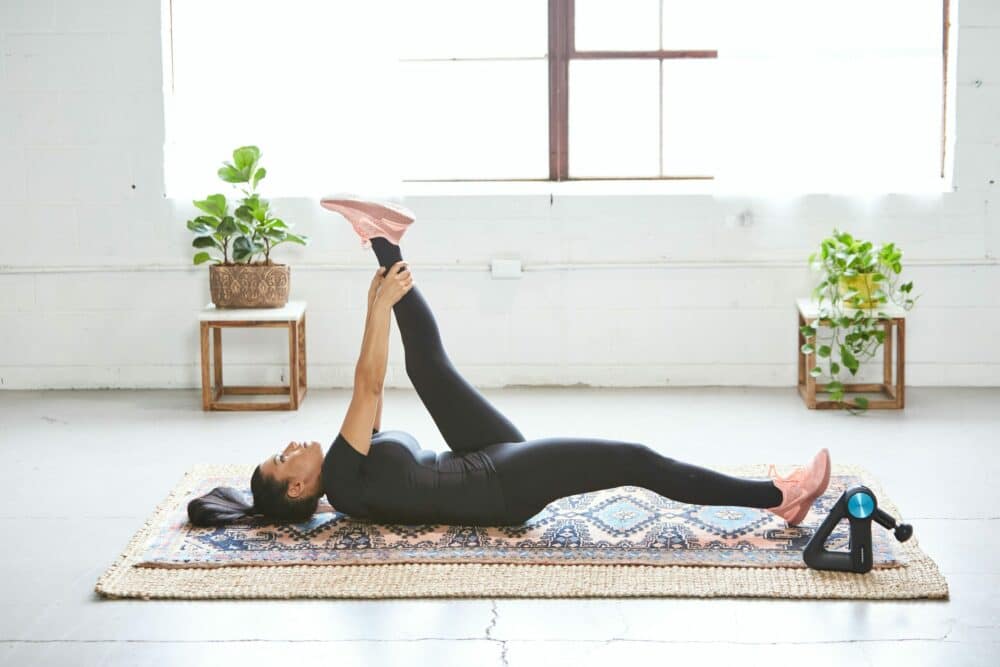
| Hip flexor stretch | Tight hips from sitting, lower back arch | Kneel in a lunge. Tuck your pelvis slightly and shift forward until you feel a stretch in the front of the back hip. | 30 seconds each side |
| Glute bridges | Weak glutes, lower back arch | Lie on your back, knees bent. Drive through your heels to lift your hips, squeeze your glutes at the top, then lower. | 2 sets of 12 to 15 |
| Dead bugs | Deep core control | Lie on your back, arms up and knees over hips. Slowly lower the opposite arm and leg while keeping your lower back steady. | 2 sets of 8 each side |
| Bird dogs | Core and back stability | On hands and knees, reach one arm forward and the opposite leg back without letting your hips rotate. Pause, then switch. | 2 sets of 8 each side |
| Planks | Core endurance | Hold a straight line from head to heels on your forearms and toes, without letting your hips sag. | 3 holds of 20 to 40 seconds |
Move slowly and stay in a comfortable range. Corrective exercises should feel like work, not pain. As they get easier, add reps, a stronger band or more weight on rows. Strength training for the whole body, especially the back, glutes and legs, helps posture changes last. For more core work, see our core strengthening exercises and plank variations. If your lower back bothers you, start with our corrective exercises for lower back pain.
A 10-minute posture workout
Do this at home or in the office, most days of the week. You need a resistance band and a little floor space.
- Cat-cow: 1 minute, moving slowly through your whole spine.
- Chin tucks: 1 minute, 10 reps with a short hold.
- Doorway chest stretch: 1 minute, two 30-second holds.
- Wall angels: 1 minute.
- Band pull-aparts: 1 minute.
- Hip flexor stretch: 1 minute, 30 seconds each side.
- Glute bridges: 1 minute.
- Dead bugs: 1 minute.
- Bird dogs: 1 minute.
- Plank: 1 minute total, broken into shorter holds if needed.
Pair it with two or three full-body strength sessions a week for the best results. For more on stretching safely, see our guide to proper stretching techniques.
Set up your desk for good posture
Your workstation can either pull you into a slump or make good posture easy. A few adjustments go a long way:
- Screen: directly in front of you, about an arm’s length away, with the top of the screen at or slightly below eye level.
- Chair: adjusted so your feet rest flat on the floor (or a footrest) and your knees are about level with your hips. Use the backrest, with support for the curve of your lower back.
- Keyboard and mouse: close enough that your upper arms hang relaxed at your sides, elbows bent at about 90 degrees or a little more open, and wrists straight.
- Laptops: raise the laptop on a stand or books and use a separate keyboard and mouse, so you are not looking down all day.
- Phone calls: use a headset or speaker instead of cradling the phone between your ear and shoulder.
- Working from home: set up a real workspace, even a small one. Long hours on the couch or in bed are hard on your neck and back.
Standing desks help some people sit less, but standing all day is not the goal either. Alternate between sitting and standing, and keep the same screen and keyboard rules when you stand.
Move more during the day
Even a perfect setup will not help if you sit still for hours. Getting up at least every 30 minutes is a good rule of thumb.
- Take microbreaks: stand, walk to get water, roll your shoulders and do a few chin tucks.
- Use reminders: a phone timer or a simple app can prompt you to get up and reset.
- Walk and talk: take phone calls standing or walking, and suggest walking meetings.
- Build movement into your commute: take the stairs, get off a stop early and look up from your phone when you can.
- Carry smart: use a backpack on both shoulders, or switch shoulders often with a bag.
Tech neck and your phone
Tech neck is forward head posture caused by looking down at phones, tablets and laptops for long periods. As the head drifts forward and down, the muscles at the back of the neck and upper back work harder to hold it up, which can leave them tight, tired and sore.
- Raise your phone closer to eye level instead of dropping your head to look at it.
- Take breaks from scrolling and look up and around every few minutes.
- Do chin tucks and a chest stretch a few times a day.
- Strengthen your upper back with rows and band pull-aparts.
- Check your screen time. Many people are surprised how many hours a day they spend looking down.
Walking posture
How you walk matters too, especially in a city where you walk a lot.
- Keep your head up and look forward, not down at the ground or your phone.
- Keep your neck, shoulders and back relaxed, not stiff.
- Let your arms swing freely with a slight bend in the elbows.
- Keep your core lightly engaged and your back straight, without arching.
- Roll through each step from heel to toe.
- Wear supportive, comfortable shoes, and save heels and thin-soled shoes for short distances.
Posture tools: what helps and what does not
- Posture correctors and braces: they can remind you to pull your shoulders back. On their own, they do not strengthen the muscles that hold good posture. Wear one for a few hours at most, pair it with exercise, and treat it as a reminder, not a fix.
- Posture apps and wearables: sensors and apps that buzz when you slouch can build awareness. Exercise and movement still do the real work.
- Lumbar support: a cushion or rolled towel can support the curve of your lower back if your chair does not.
- Laptop stand, keyboard and mouse: probably the most useful posture purchase if you work on a laptop.
- Standing desk or converter: helpful for breaking up sitting, as long as you alternate.
- Resistance bands and a foam roller: inexpensive tools that cover most of the exercises in this guide.
Posture as you age
Some rounding of the upper back is common with age, from years of habit, loss of muscle and, for some people, bone loss. Rounding from slouching (postural kyphosis) is the most common type overall and often improves with exercise. In older adults, a growing curve is more often linked to weak bones: osteoporosis can lead to small fractures in the spine that increase rounding and cause height loss.
The best defense is the same at any age: strengthen your back and legs, stay active with weight-bearing exercise such as walking, practice balance and keep up good posture habits. Getting enough calcium, vitamin D and protein supports bone health too. If you notice new back pain, height loss or a curve that is getting worse, talk to your doctor about a bone density check. If you have osteoporosis or have had a spine fracture, ask your doctor or a physical therapist which exercises are right for you. For a safe place to start, see our guide to the best strength training exercises for seniors.
When to see a doctor or physical therapist
Posture exercises are safe for most people, but get checked by a doctor or physical therapist if you have:
- Numbness, tingling or weakness in your arms or legs
- Neck or back pain that is severe, keeps getting worse, wakes you at night or has not started to improve after about a week
- Pain that spreads down a leg below the knee, or into an arm
- Back pain with a fever or unexplained weight loss
- Pain after a fall or injury
- A curve in your spine, or a difference in shoulder or hip height, that is new or changing
- Noticeable height loss
Get emergency care for new trouble controlling your bladder or bowels, or for pain after a car crash or bad fall.
If you are finishing physical therapy, a trainer can help you keep building on that work.
Working with a trainer
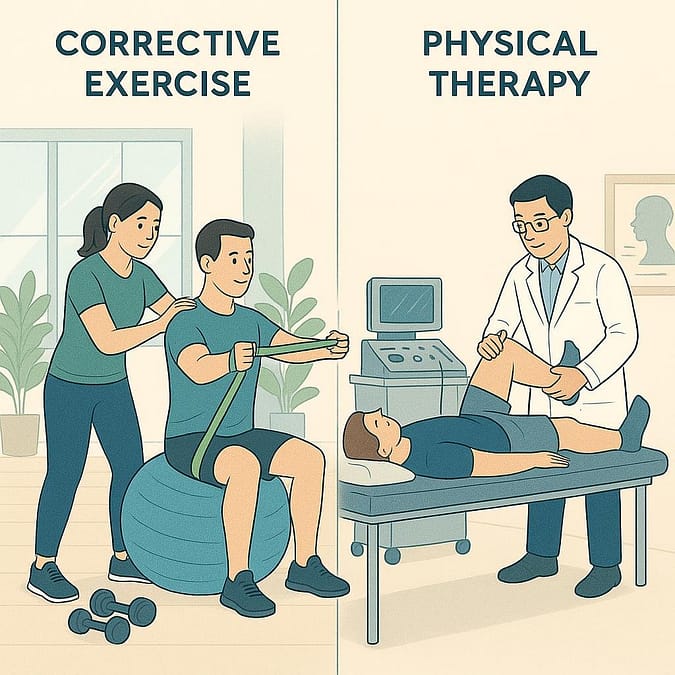
A good trainer can see what you cannot: how your posture and movement look from every angle, which muscles are doing too much and which are not doing enough. They can then build a plan that targets your specific imbalances, coach your form and progress the program as you get stronger. For more on what this kind of specialist does, see our corrective exercise specialist guide.
A Type A Training corrective exercise trainer comes to your home or building gym in Manhattan, starts with a 75-minute movement and posture assessment, and builds a 6- or 8-week program around what it finds. Learn more about corrective exercise and posture training.
Frequently asked questions
How long does it take to improve posture?
It varies. Some people feel less stiff and more aware of their posture within a few weeks of regular exercise and better habits. Lasting change in strength and in how you naturally hold yourself takes longer, often several months of consistent work.
Can you fix years of bad posture?
Often, yes. Posture problems linked to habits and muscle imbalances often respond well to strengthening, stretching and a better daily setup, at any age. Structural problems, such as scoliosis or a curve caused by bone changes, need a doctor’s input.
Do posture correctors work?
They can remind you to sit or stand taller, but they do not build the muscles that hold good posture. Use one for short periods if it helps, and pair it with exercise.
How often should I get up from my desk?
Aim to stand up and move at least every 30 minutes, even for a minute or two. Short breaks spread through the day help break up long stretches of sitting.
Is standing better than sitting?
Neither is ideal for hours at a time. The goal is to change position often. A standing desk can help you sit less, but alternate between sitting and standing.
Can core training improve posture?
Yes. Your core, including the deep abdominal muscles, back muscles and glutes, helps hold your spine and pelvis in position. Pair core work with upper back strengthening for the best results.
Can poor posture cause back pain?
It can contribute, especially when you stay in one position for a long time. But research suggests the link between posture and pain is weaker than most people think. Staying active, getting stronger and changing position often matter more than holding a perfect posture.
What is the best sleeping position for posture?
There is no single best position. Sleeping on your back or side with a pillow that keeps your head in line with your spine is comfortable for most people. Side sleepers often like a pillow between the knees, and back sleepers a pillow under the knees.
Our corrective-exercise specialists rebuild posture and movement at home, assessment first, then a plan built for your body.
Meet our corrective specialists