Qualifying for the New York City Marathon in 2027: Times, Entry and Training
The TCS New York City Marathon is one of the largest marathons in the world. According to New York Road Runners (NYRR), 59,226 runners finished in 2025, a world record at the time, and more than 240,000 people applied to the drawing for the 2026 race, with only about 1 percent accepted. That is why it pays to know every route in.
This guide covers the 2027 qualifying times and every way to get an entry, the course, a beginner training plan, mental preparation, a race-day strategy built around the course, and what to know if you are running on November 1, 2026.
The short version
- The 2026 race is Sunday, November 1, 2026. The 2027 race is Sunday, November 7, 2027.
- To time-qualify for 2027, run the standard for your age and gender between January 1 and December 31, 2026. Times from NYRR-scored races guarantee entry. Times from other marathons compete for a limited number of spots.
- Other routes for 2027 include running for a charity, NYRR’s 9+1 program (the 2026 program still counts), cancelling a 2026 entry by October 31, 2026, finishing the race 15 or more times, and the drawing.
- NYRR has not announced the 2027 drawing dates yet. In recent years, applications opened in early February and the drawing was held in early March.
- Many first-time marathoners train for 16 to 20 weeks, build their long run gradually and taper for 2 to 3 weeks.

How to get into the 2027 NYC Marathon
NYRR lists every entry route on its Run in 2027 page. Most application and claim dates are still to be announced, and NYRR notes that all dates are subject to change, so check that page before you plan around a deadline.
Time qualifying
Run a qualifying time between January 1 and December 31, 2026, based on your age on race day, November 7, 2027. NYRR uses your net (chip) time. There are two ways to qualify:
- NYRR-scored races (guaranteed): the 2026 NYC Half, Maybelline Women’s Half, Brooklyn Half, Staten Island Half and the 2026 TCS New York City Marathon. Qualifying times appear on your NYRR account automatically, and you claim your entry during the claim period.
- Other marathons (limited): full marathons only, on a course officially measured and approved by USATF, AIMS, World Athletics or the host country’s governing body. Indoor marathons, triathlons and times from Strava or a GPS watch do not count. Your time must appear in the race’s official results. NYRR offers a limited number of these entries. If more runners apply than there are spots, the fastest in each age and gender group get in, and the rest go into the drawing.
The last NYRR-scored qualifiers in 2026 are the Staten Island Half on October 11 (sold out) and the marathon on November 1. If you are not already entered in one of them, your remaining option is a marathon on an officially measured course by December 31, 2026, and those entries are limited.
These are NYRR’s 2027 time-qualifying standards. Half marathon times count only at the NYRR half marathons listed above. Nonbinary runners use the same standards as women.
| Age on Nov. 7, 2027 | Men: marathon | Men: NYRR half | Women: marathon | Women: NYRR half |
|---|---|---|---|---|
| 18 to 34 | 2:53:00 | 1:21:00 | 3:13:00 | 1:32:00 |
| 35 to 39 | 2:55:00 | 1:23:00 | 3:15:00 | 1:34:00 |
| 40 to 44 | 2:58:00 | 1:25:00 | 3:26:00 | 1:37:00 |
| 45 to 49 | 3:05:00 | 1:28:00 | 3:38:00 | 1:42:00 |
| 50 to 54 | 3:14:00 | 1:32:00 | 3:51:00 | 1:49:00 |
| 55 to 59 | 3:23:00 | 1:36:00 | 4:10:00 | 1:54:00 |
| 60 to 64 | 3:34:00 | 1:41:00 | 4:27:00 | 2:02:00 |
| 65 to 69 | 3:45:00 | 1:46:00 | 4:50:00 | 2:12:00 |
| 70 to 74 | 4:10:00 | 1:57:00 | 5:30:00 | 2:27:00 |
| 75 to 79 | 4:30:00 | 2:07:00 | 6:00:00 | 2:40:00 |
| 80 and over | 4:55:00 | 2:15:00 | 6:35:00 | 2:50:00 |
NYRR 9+1
Through the 9+1 program, NYRR members who finish nine qualifying NYRR races and complete one qualifying volunteer shift in 2026, and who keep an active membership through December 31, 2026, earn guaranteed entry to the 2027 race. You still pay the entry fee, and the entry does not roll over to a later year.
The program is changing for the 2028 race. Members now have to be picked in a 9+1 eligibility drawing before they can start, and the first one was held on October 1, 2026. That drawing covered 9+1 entry for the 2028 race, so for 2028 the program is now open only to members who were selected. If you want to use 9+1 for a later year, watch for NYRR to announce its next eligibility drawing.
Running for a charity
Many runners earn their entry by fundraising for one of NYRR’s Official Charity Partners. Each charity sets its own minimum, but NYRR requires its Bronze partners to set a minimum of at least $3,000 per runner and its Silver partners at least $3,500, and many charities set higher minimums. NYRR’s own charity, Team for Kids, required a $3,000 commitment for a general entry in 2026. NYRR says the 2027 charity list will be announced in the spring of 2027.
Cancelling a 2026 entry
If you have a 2026 entry and cannot run, NYRR’s cancellation policy lets you cancel online by 11:59 p.m. ET on Saturday, October 31, 2026, and earn guaranteed entry for 2027. You pay the 2027 entry fee when you claim it. This does not apply if your 2026 entry came from cancelling in 2025, and charity and tour operator entries follow their own rules.
The drawing
Everyone else applies to the drawing, which NYRR runs in three pools: the New York City metro area (within 60 miles), the rest of the United States, and international runners. NYRR members who apply are also entered in a member-only second-chance drawing. For the 2026 race, applications ran from February 4 to 25, 2026, the drawing was held on March 4, and about 1 percent of more than 240,000 applicants got in.
Other routes
- 15 or more finishes: runners who have finished the New York City Marathon 15 or more times earn guaranteed entry.
- International tour operators: runners who are not full-time US residents can buy a travel package with a guaranteed entry from an official tour operator.
- NYRR philanthropic memberships: higher-level donor memberships include guaranteed entry.
Entry fees for the 2026 race were $255 for NYRR members and $315 for non-members. NYRR has not published 2027 fees.
The course
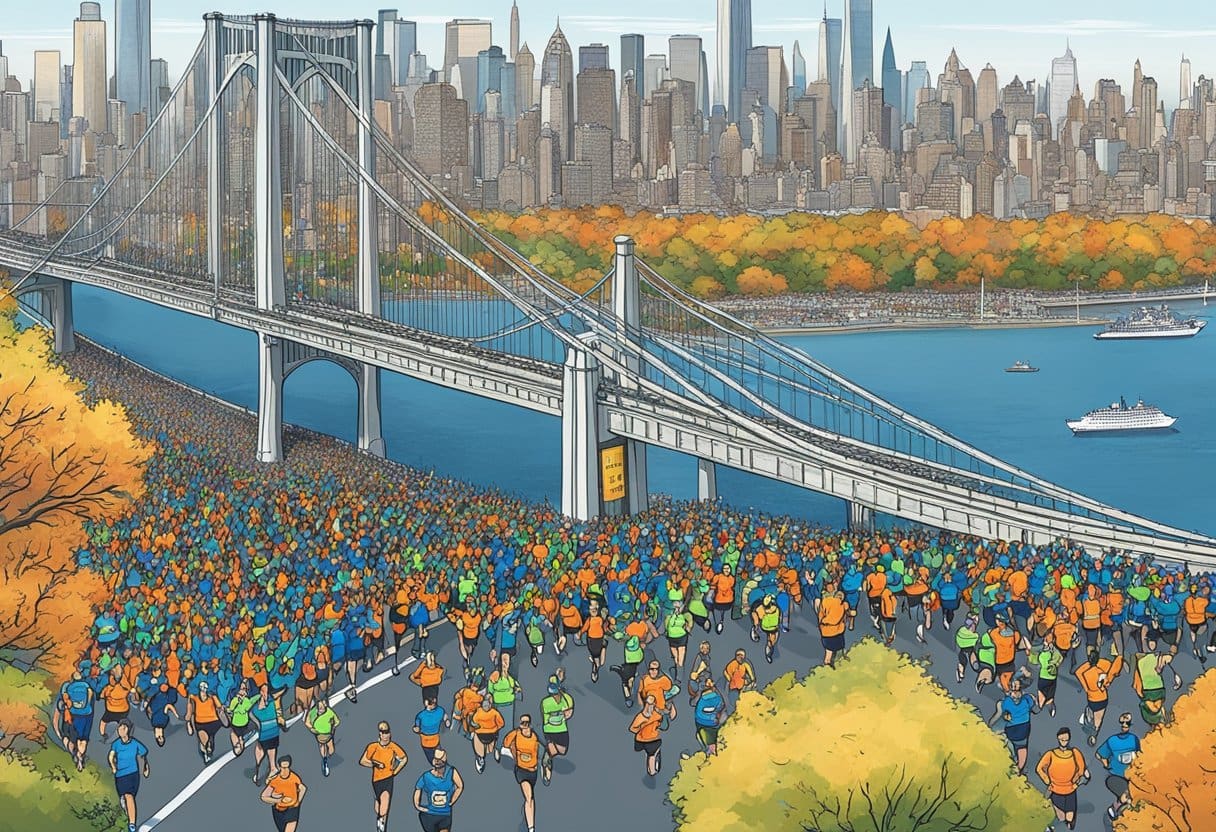
The 26.2-mile course runs through all five boroughs. It starts at Fort Wadsworth on Staten Island, crosses into Brooklyn on the Verrazzano-Narrows Bridge, then runs through Queens, Manhattan and the Bronx before finishing in Central Park at West 67th Street. The course crosses five bridges, in this order: the Verrazzano-Narrows, Pulaski, Queensboro, Willis Avenue and Madison Avenue bridges. NYRR’s course page has the full map.
- Miles 1 to 2: the Verrazzano-Narrows Bridge, the biggest climb on the course, straight from the start.
- Miles 2 to 13: Brooklyn, along Fourth Avenue and through Williamsburg and Greenpoint, with big crowds.
- Halfway: the Pulaski Bridge into Queens at mile 13.1.
- Around miles 15 to 16: the Queensboro Bridge into Manhattan, a long climb where spectators are not allowed, then First Avenue from mile 16 to 18.
- Around miles 20 to 21: a short loop through the Bronx, crossing the Willis Avenue Bridge in and the Madison Avenue Bridge back out.
- Miles 23 to 24: a gradual climb as you head south on Fifth Avenue from East 105th to East 90th Street, where you enter Central Park.
- The last 2 miles: rolling hills in Central Park, a stretch along Central Park South and back into the park to the finish.
The 2026 race marks 50 years of the five-borough course, and it brings the first course change in 15 years: two turns in the Bronx section have been removed. NYRR records official finish times through 10:00 p.m. on race day.
A beginner marathon training plan
There is no official standard for how to train for a first marathon, but many coaches suggest building a base of regular running, several days a week, before you start a plan. Most marathon plans last 12 to 20 weeks, many first-timers choose 16 to 20, and NYRR’s own training program runs 16 weeks. This is a typical 18-week structure:
| Phase | Weeks | Focus | Long run |
|---|---|---|---|
| Base | 1 to 6 | Easy running 3 or 4 days a week, plus strength training twice a week | 6 to 10 miles |
| Build | 7 to 12 | Add one faster session a week, such as a tempo run or miles at goal marathon pace | 10 to 16 miles, with an easier week every third week |
| Peak | 13 to 15 | Your highest mileage. Practice your race-day fueling, pace and gear on long runs. | 16 to 20 miles |
| Taper | 16 to 18 | Cut weekly mileage step by step while keeping some running at goal pace | About 12 miles, then 8 to 10, then race day |
- Build gradually. In a 2025 study of 5,205 runners, a single run more than 10 percent longer than the longest run in the previous 30 days was linked to a higher injury risk. Make each new long run only a little longer than your longest run in the past month, ideally by no more than about 10 percent.
- Run most miles easy. You should be able to talk in full sentences on easy runs. Save harder efforts for one session a week.
- Taper on purpose. A meta-analysis of tapering found the best results from about two weeks of reduced training, cutting volume by roughly 40 to 60 percent while keeping the intensity. For a marathon, many runners taper over about three weeks.
- Strength train. Two short sessions a week for your hips, legs and core help you handle the mileage. See our guide to strength training for runners.
- Train for the course. Include hills in your long runs. In Manhattan you can run the real thing: East Drive in Central Park, from East 90th Street down to Central Park South, is the race route, and the hills at the north end of the park add extra climbing.
Mental preparation

A review of the research on endurance performance found consistent support for three mental skills: imagery, self-talk and goal setting. Practice them in training so they are ready on race day:
- Set three goals. An A goal for a great day, a B goal for an average one and a C goal, such as finishing strong, for a hard one.
- Use short, positive self-talk. Pick a few phrases, such as “smooth and steady” or “one mile at a time,” and use them on the hard parts of long runs.
- Rehearse the course in your head. Picture the climb up the Verrazzano, holding back on First Avenue and staying patient up Fifth Avenue.
- Break the race into sections. Think borough by borough instead of 26.2 miles at once.
- Plan for a bad patch. Expect at least one. Decide in advance what you will do: slow down a little, take a gel, focus on your form, and keep moving.
Race-day strategy for the NYC course
- Start slower than goal pace. A study of 1.7 million recreational marathon finishes found that even pacing leads to the best finish times and that fast starts often lead to trouble later. The Verrazzano climb in mile 1 makes holding back easier.
- Do not let the crowds pick your pace. Brooklyn and First Avenue are loud and exciting, and it is easy to speed up without noticing.
- Run the bridges by effort, not pace. Your pace will slow on the Queensboro Bridge. Keep the effort steady and let it come back on the way down.
- Save something for Fifth Avenue and the park. The gradual climb at miles 23 to 24 and the rolling hills in Central Park come when you are most tired.
- Fuel early and often. Sports nutrition guidance suggests 30 to 60 grams of carbohydrate an hour during long events, and up to 90 grams an hour for events longer than about 2.5 hours if you have practiced it in training. NYRR offers gels at only two points, so carry your own and use the brand you trained with.
- Drink to thirst, as NYRR advises. Water and Gatorade are at almost every mile. Drinking far more than you need can cause hyponatremia, a dangerous drop in blood sodium, and a study of Boston Marathon runners found slower finishers were at higher risk. Do not drink at every station just because it is there.
If you are running on November 1, 2026
NYRR’s runner guide and your NYRR account have the final details for your entry. These are the key points from NYRR’s race pages:
- Getting to the start: you take the transportation option and time you chose in your NYRR account, such as the Staten Island Ferry and a bus, or a bus from Midtown or New Jersey. It is printed on your bib.
- Wave starts: NYRR lists five waves, starting from 9:10 a.m. to 11:30 a.m. Start times can change, so check your bib and your account.
- Bags: the clear start village bag from the Expo is the only bag allowed at the start, and there is no bag check at the start. If you chose bag pre-check, drop it off on Central Park West on October 30 or 31. Every finisher gets a poncho.
- Layers: wear old clothes you can leave in the start village. NYRR donates them to New Yorkers in need.
- On the course: water and Gatorade Endurance Formula are at every mile from mile 3 to mile 25 except miles 5, 7 and 9. Maurten gels are at miles 12 and 18 while supplies last, and bananas at mile 21.
- Medical help: medical stations are about every mile from mile 3 and at the finish. If something feels wrong, stop and ask for help.
Working with a trainer
A trainer can build your plan around your schedule, add the strength work that keeps you running through peak weeks, and help you settle on a realistic goal pace. A Type A Training trainer comes to your home, your building gym or a park in Manhattan, so your sessions can include the Central Park hills you will face in the final miles. Learn more about in-home personal training. Choosing race shoes? See our guide to carbon plate running shoes, and for technique, our good running form guide.
Frequently asked questions
What are the NYC Marathon qualifying times for 2027?
For the 18 to 34 age group, the marathon standard is 2:53:00 for men and 3:13:00 for women, with qualifying times run between January 1 and December 31, 2026. The full table by age is above.
When is the drawing for the 2027 NYC Marathon?
NYRR has not announced the dates yet. For the 2026 race, applications ran from February 4 to 25, 2026, and the drawing was held on March 4, 2026.
Does a Boston Marathon qualifying time get me into New York?
Not automatically. New York has its own standards. A time from another marathon on an officially measured course counts only if it meets the New York standard for your age and gender, and those entries are limited.
How much does it cost to run the NYC Marathon?
The 2026 entry fee was $255 for NYRR members and $315 for non-members. Charity runners also commit to a fundraising minimum, usually $3,000 or more.
Work with a trainer who comes to you: home, building gym, or park. Matched to your goals, not just whoever’s available.
Get matched with a trainer