Sheiko Programs Guide: Elite Powerlifting Training Methods
Sheiko programs have built a legendary reputation in the powerlifting world for good reason. These Russian-designed training systems focus on technical mastery and smart volume distribution, not just pushing you to failure every session.
Sheiko programs typically feature twice weekly squatting, once weekly deadlifting, and three bench sessions per week. This creates a balanced approach that builds strength while keeping fatigue and injury risk in check.
If you’re aiming to take your powerlifting up a notch, understanding Sheiko’s methodology is essential. The programs use submaximal weights, mostly 70-80% of your 1RM, with the average landing near 70%, for multiple sets.
That might sound easy at first, but it builds impressive strength over time. Unlike many Western programs that chase intensity, Sheiko’s approach puts perfect technique front and center through frequent practice with manageable loads.
Sheiko originally created these programs for elite Russian lifters, but they’ve been adapted for all levels. From a six-week novice routine to numbered templates and licensed cycles that run 4 to 26 weeks, you’ll find a Sheiko program that fits your experience and competition goals.
Key Takeaways
- Sheiko programs rely on submaximal weights with high frequency and volume to build strength and technical skill.
- You can find Sheiko routines for everyone, from total beginners to advanced competitors prepping for big meets.
- Doing Sheiko right takes patience, attention to technique, and tweaking accessory work to suit your own weak spots.
Overview of Sheiko Programs
Sheiko programs have a reputation for their methodical approach to strength. These high-volume protocols focus on technical mastery and progressive overload, but always with a close eye on fatigue.
History and Development of Sheiko Program
The Sheiko program started in Russia back in the Soviet era, when sports science was a really big deal. Boris Sheiko built his training system through the 1990s, first as head coach of Kazakhstan’s powerlifting teams from 1991, then with the Russian national team after moving to Russia in 1997 (Sheiko interviews with Juggernaut Training Systems, 2015, and Stronger by Science).
His approach got noticed fast, as his athletes started dominating international competitions. Rather than chasing intensity like many Western methods, Sheiko built a system around submaximal loads and higher frequency.
That meant lifters could get in more quality practice without wearing themselves out. The programs evolved through hands-on work with world-class athletes.
What began as handwritten logs eventually became structured training templates that lifters everywhere now use.
The Influence of Boris Sheiko and Russian Powerlifting
Boris Sheiko stands out as one of the most successful powerlifting coaches ever. As head coach of Russia’s men’s team, he says the squad won the European and World championships seven times between 1999 and 2005 (Juggernaut interview, 2015).
His influence isn’t limited to Russia, his methods have spread worldwide. Sheiko’s coaching philosophy puts precise technique over ego lifting, making his approach work for lifters at all levels.
What really sets Sheiko apart is his scientific mindset. He tracks each athlete’s progress and tweaks the plan based on how they respond to training.
Today, Sheiko shares his methods through seminars, books, and digital platforms, making them accessible for lifters everywhere.
Core Principles of Sheiko Training
Sheiko programs rest on a few core ideas. First, there’s a big focus on technical proficiency, you’ll do lots of submaximal lifts to nail your movement patterns before you ever touch maximal weights.
Second, Sheiko values intelligent volume management. Instead of pushing you to failure, you’ll work mostly at 70-80% of your one-rep max, building volume through multiple sets.
The training uses a wave-like periodization structure, with intensity and volume rising and falling over the program. This helps prevent burnout and keeps you progressing.
Specificity matters too. You’ll mainly work on the competition lifts, squat, bench, deadlift, and their close variations, so your training translates straight to the platform.
Frequency is huge, expect to train each lift 2-3 times a week, giving you more chances to practice and refine your technique.
Structure and Methodology
Sheiko programs break training into clear blocks and balance volume and intensity with care. The goal is to develop technique through frequent practice of competition lifts, always with submaximal weights.
Periodization and Block Phases
Sheiko’s methodology runs in cycles rather than linear progression: a preparatory period of roughly ten weeks and a competition period of about four, with small, medium and large loads alternated week to week and a lighter week about every fourth (Sheiko, Juggernaut seminar notes). The four-block labels you see on the numbered templates (preparatory, accumulation, transmutation, peaking) come from reviewers such as PowerliftingToWin, not from Sheiko himself, but they describe how the templates feel.
The preparatory block lays the groundwork for work capacity and technical skill. You’ll build up your volume tolerance using medium intensity (70-80% of 1RM) loads.
During the accumulation block, the volume ramps up but intensity stays similar. This phase pushes adaptation with more work, but not more fatigue.
The transmutation block gets more competition-specific. You’ll drop the volume a bit but bump up intensity (80-85% of 1RM) to turn all that work into real strength.
Some advanced Sheiko templates even add a peaking phase, where intensity climbs to 85-90% and volume drops off to get you ready for meet day.
Volume, Intensity, and Adaptation
Sheiko’s all about high volume with moderate intensity. Instead of maxing out all the time, you’ll use submaximal weights.
Most sessions stay between 70-80% of your 1RM, with the average landing near 70%. That means you can do more volume without frying your nervous system.
You’ll hit competition lifts often, maybe squats and bench 2-3 times a week, deadlifts 1-2 times. Technical mastery always comes before chasing PRs.
Expect lots of doubles, triples and sets of five, not endless heavy singles; singles above 90% are rare and belong to the competition block. The program spreads volume across the week, mixing medium and high volume days to manage fatigue.
Template Design and Training Weeks
Sheiko programs usually run on a 3-day split, Monday, Wednesday, Friday, with each day mixing competition lifts and accessories. You won’t see single-lift days here.
A typical week might look like:
- Monday: Bench press + Squat
- Wednesday: Bench press + Deadlift variations
- Friday: Bench press + Squat
Templates can last anywhere from 4 to 16 weeks, depending on your classification and goals. The numbered templates (#29, #30, #31, #32) line up with different prep phases and athlete types.
Exercise selection stays pretty consistent, with variations added to tackle specific weaknesses. Bench press shows up every session, a nod to the Russian focus on technical development.
Instead of linear progression, Sheiko uses wave-like loading throughout the weeks. That means periods of higher and lower stress, which helps drive adaptation.
Types of Sheiko Programs
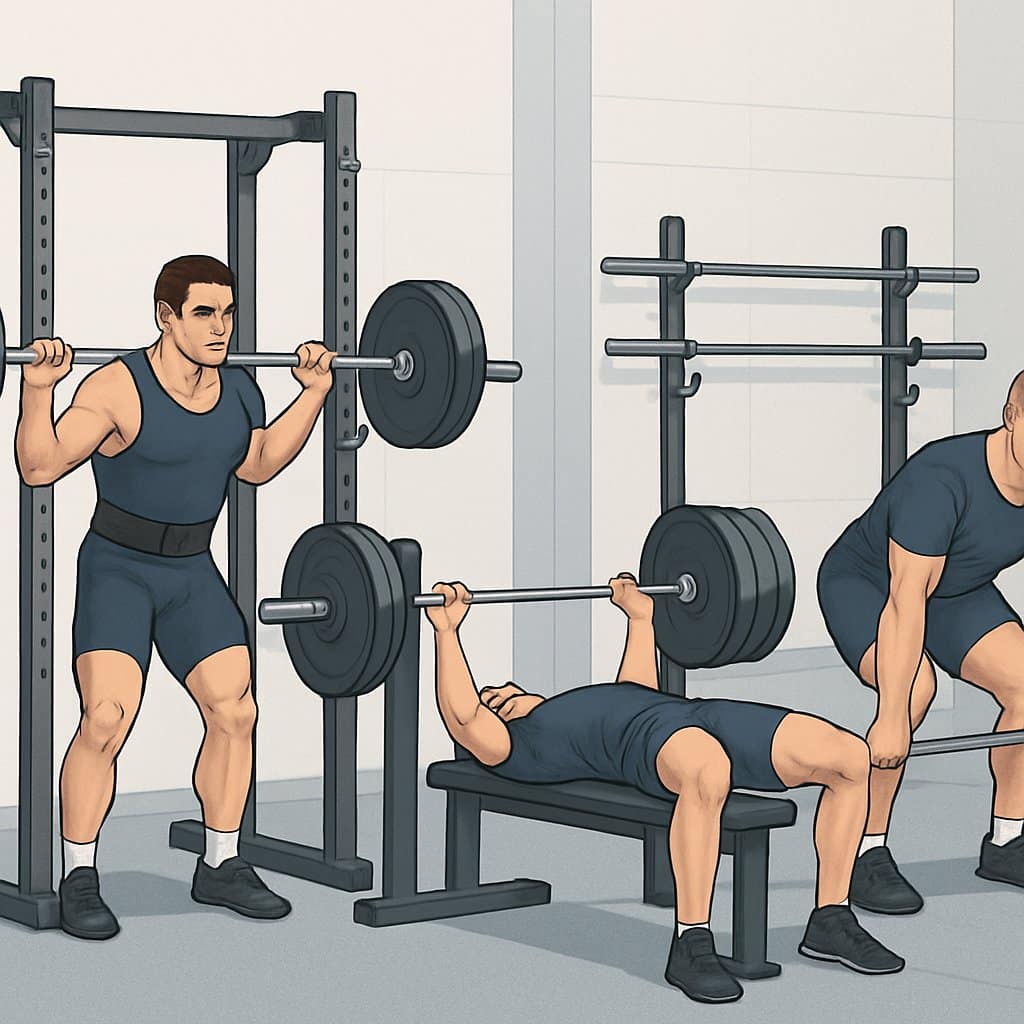
Sheiko programs break down by experience level and training needs. Each template offers a different mix of volume and intensity, so you can find one that matches your stage in powerlifting.
Sheiko Beginner Program Structure
The Sheiko beginner program is where you’ll want to start if you’re new to powerlifting or just getting into structured strength work. Here’s what you can expect:
- 3 training days per week
- Moderate volume, not overwhelming
- Heavy focus on technique
- Submaximal weights (mostly 70-80% of 1RM)
Beginners will squat twice a week, bench three times, and deadlift once. That kind of frequency helps you build technical skill without burning out.
The beginner program really drills proper form over heavy weights. You’ll do multiple sets with reasonable reps (usually 2-5) to build strength and muscle memory.
Intermediate Programs: Small and Large Load
Once you move up, the Sheiko intermediate programs come in small, medium and large load versions, assigned by your classification and bodyweight. The big difference is in volume and intensity.
Go with the small load if you:
- Have limited recovery
- Are coming back from a break
- Need more technical work at moderate volume
The large load version brings:
- More total training volume
- Extra accessory exercises
- Greater frequency for main lifts
- More varied rep ranges and intensities
Both intermediate options keep Sheiko’s high-frequency, submaximal style. You’ll still squat and bench several times a week, and deadlift at least once.
These templates usually run in 4-week cycles and you can repeat or swap them based on how you’re recovering and progressing.
Advanced and Bench-Only Templates
The advanced Sheiko programs are the most demanding. There are three main versions:
- Advanced Small Load – Best for lighter lifters or those with less recovery
- Advanced Medium Load – The go-to advanced plan for most
- Advanced Large Load – For heavyweight or enhanced lifters
Advanced templates have more specialized prep phases and competition cycles. You’ll get more varied intensities, specialized lifts, and planned deloads.
If you’re all about bench press, Sheiko bench-only programs offer:
- 3-4 bench sessions per week
- Different grip widths and tempos
- Accessories to target weak points
- Structured loading to keep fatigue in check
These templates let you zero in on specific weaknesses but still follow Sheiko’s proven approach.
Key Exercises and Accessory Work
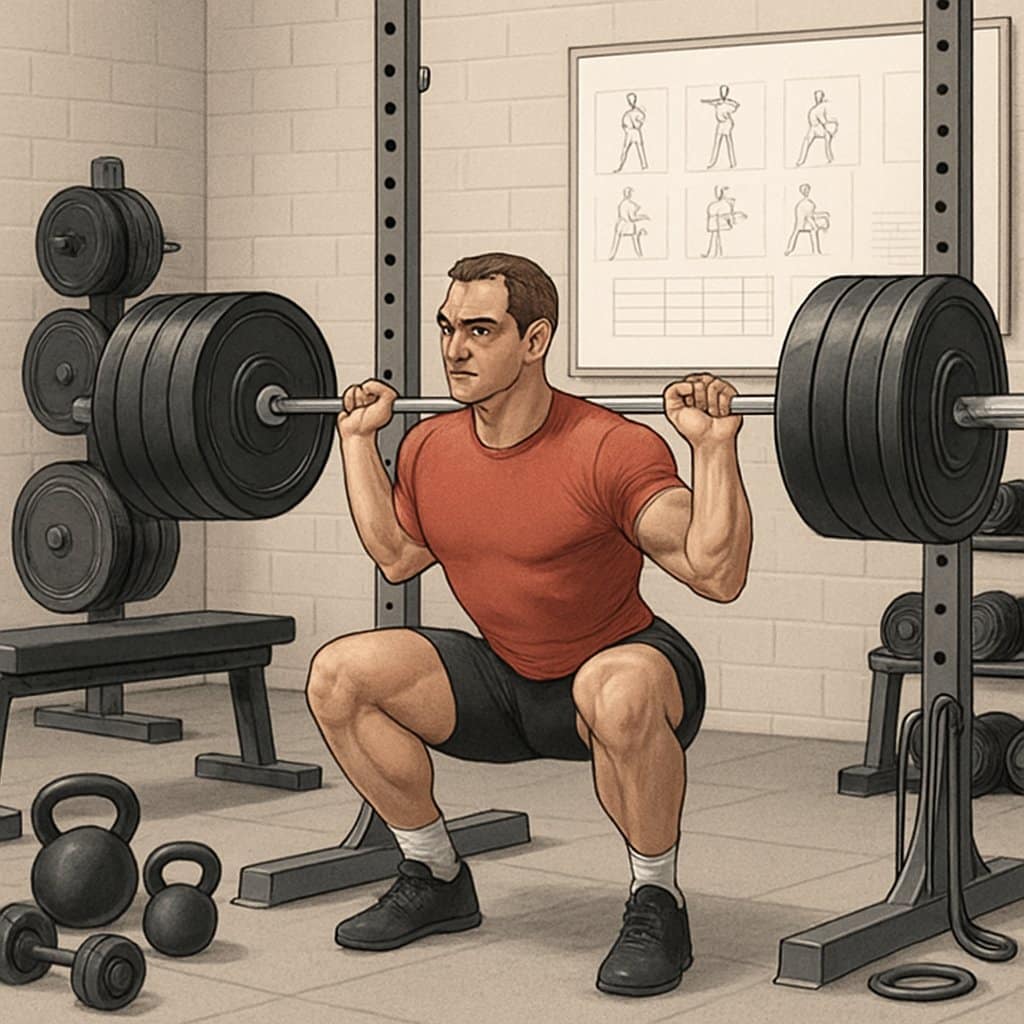
Sheiko programs build strength and technique with a smart selection of exercises. The training centers on competition lifts at moderate intensity and high volume.
Core Lifts: Squat, Bench Press, and Deadlift
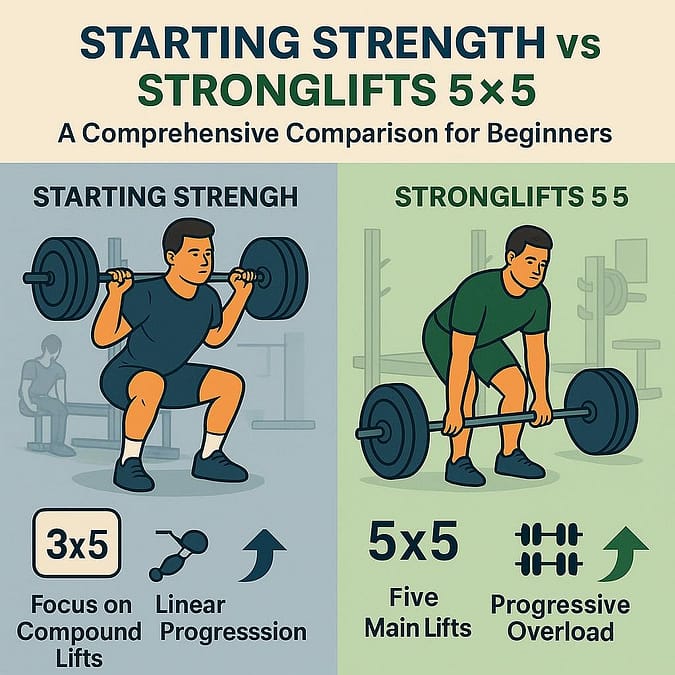
The squat, bench press, and deadlift are the backbone of every Sheiko program (if you are newer to the barbell, our Starting Strength vs StrongLifts comparison is the place to start). Unlike some other systems, Sheiko has you hit these core lifts several times a week, often 2-3 for bench and squats, and 1-2 for deadlifts.
You’ll see the main lifts in different forms, too. Expect competition-style lifts alongside variations like:
- Squat variations: box squats, pause squats
- Bench variations: close-grip, paused bench press
- Deadlift variations: deficit deadlifts, deadlifts to knees
Sheiko stands out for how it spreads intensity. You’ll rarely go above 85% in training, with most work in the 60-80% range. That lets you keep technique sharp and rack up enough volume for real progress.
Role of Accessory Exercises
Accessory exercises in Sheiko programs aren’t just for “bodybuilding.” They exist to target weak spots and build the muscles you need for the big lifts.
Hyperextensions, abdominal exercises, and box jumps get a surprising amount of attention. You’ll see plenty of lower back exercises like hyperextensions and good mornings in these routines.
Your accessory work should focus on:
- Strengthening lagging muscle groups
- Improving strength in specific positions
Building overall work capacity matters too.
Some Sheiko variations add dumbbell exercises to address muscle imbalances. These accessories aren’t random; they’re picked to help your main lifts progress.
Technique Improvement and Specificity
Technique work sits at the heart of Sheiko’s approach. The moderate weights let you practice perfect form over and over, which really engrains good movement.
Specific technique drills include:
- Paused variations: help with body awareness
- Tempo lifts: teach control during the lowering phase
- Position-specific work: target weak spots in the lift
Sheiko lifters take time to develop, slowly increasing tonnage while mastering form. Quick PRs aren’t the focus here.
Your technique work should look a lot like your competition lifts. That’s why Sheiko programs work so well for powerlifters, they reinforce the skill of the main lifts every session.
Progression, Outcomes, and Notable Lifters
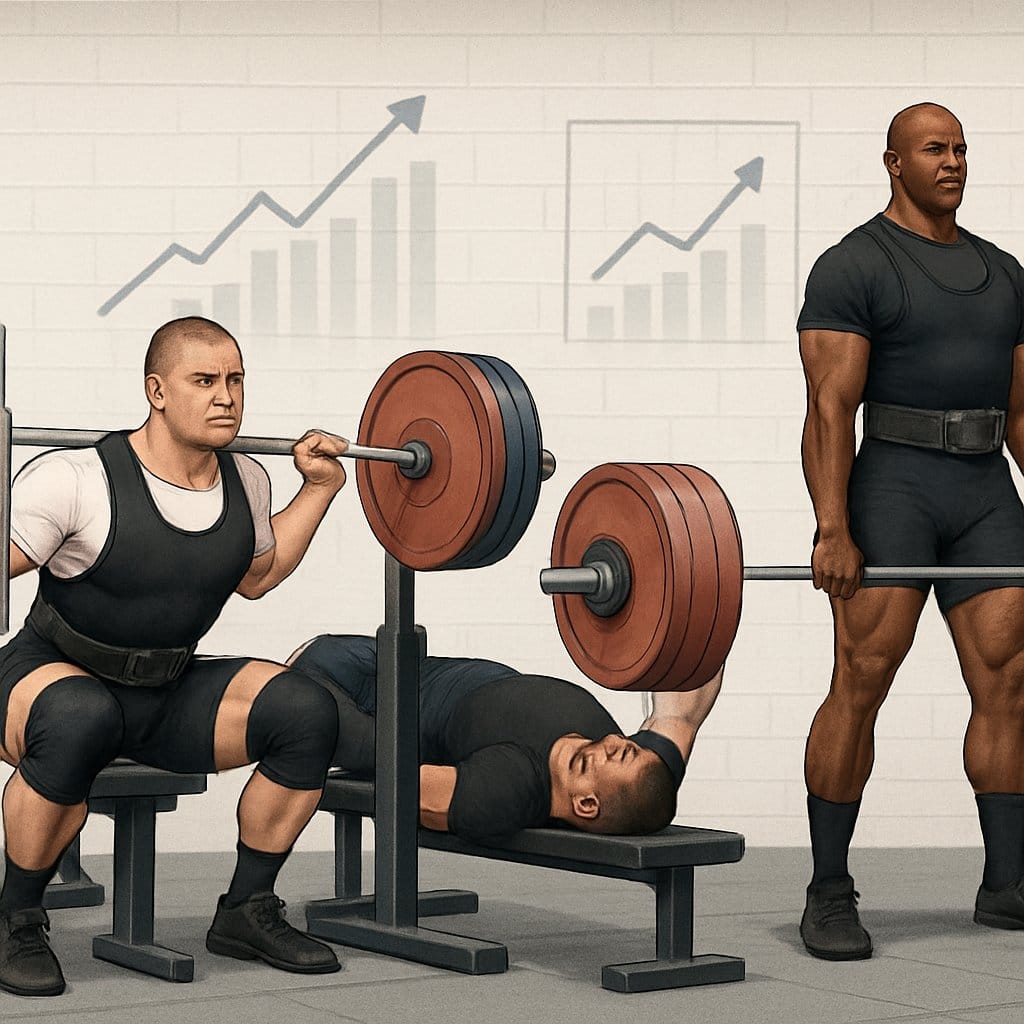
Sheiko programs build strength with a steady, methodical progression. They’re based on decades of Russian powerlifting results.
You’ll spend a lot of time working on perfect technique under high volume.
Strength Gains and Muscle Mass Development
Sheiko’s approach to strength is a bit different from what you see in most Western programs. Instead of chasing percentage-based PRs every month, Sheiko lifters peak after years, with small, steady gains adding up.
If you run Sheiko properly, you’ll notice your strength goes up thanks to better technique and improved neural efficiency, not just bigger muscles. After a full cycle, your 1RM might not shoot up dramatically, but the progress is real.
Sheiko programs scale by experience level, so newer lifters get less volume and intensity. As you gain experience, you’ll handle more work and recover better.
Most of your work happens with submaximal weights (mostly 70-80% of 1RM). This lets you practice good form and get stronger without frying your nervous system.
Hypertrophy and High Volume Approach
Sheiko’s high volume style actually promotes muscle growth, even though it’s not a hypertrophy program. The training volume is high enough to stimulate muscle gains, especially in the main movers.
You’ll usually squat 2-3 times a week, bench 3-4 times, and deadlift 1-2 times. That adds up fast.
A typical Sheiko workout often includes 6-8 sets of the main lifts plus accessories, sometimes totaling over 20 sets in a session.
This repeated exposure to relatively heavy weights creates the tension muscles need to grow. You won’t get the same dramatic size as a bodybuilder, but most people see solid gains in their quads, upper back, and chest.
Famous Sheiko Lifters and Results
Boris Sheiko has coached a lot of world champions and record holders. Andrey Belyaev stands out as one of the Russian team’s strongest lifters of that era: IPF World Champion at 90 kg in 2007 with a 977.5 kg total, plus two World Junior titles and the 2005 IPF World Bench Press title (OpenPowerlifting).
Kirill Sarychev, whose 335 kg (738 lb) raw bench in 2015 stood as the world record until 2019, trained under Sheiko for a period after 2010. His technical skill really shows the program’s focus on form.
Other names worth mentioning:
- Yuri Fedorenko (IPF World Champion at 110 kg in 2003, runner-up four times)
- Alexei Sivokon (seven IPF world titles at 67.5 kg, coached by Sheiko on the Kazakhstan team)
- Maxim Podtynny (IPF World Champion at 125 kg in 1998 and 1999)
These lifters didn’t just win, they stayed at the top for years. Sheiko’s slow, steady progression seems to help people avoid burnout and injuries.
When you look at their careers, you see steady improvement, not wild jumps followed by long plateaus.
Practical Guidance and Tools
To run Sheiko effectively, you need to understand the structure and have tools to track progress. That way, you can stay on course and tweak things as needed.
Adapting Sheiko for Individual Needs
Sheiko programs work as templates. You can adjust them to fit your weak points and goals.
If your bench press lags, add more bench accessories on lighter days. But don’t get carried away, major changes to the core structure should be rare and best done with a coach’s input.
Big modifications can backfire.
A few smart ways to adapt:
- Training frequency: Shift from 3-4 days a week to match your schedule
- Exercise selection: Swap in variations that hit your weak spots
- Volume adjustment: If recovery suffers, cut total sets by 10-20%
Sheiko’s programming already aims to improve technique and build strength, so start with small tweaks.
Tracking Progress With Spreadsheets and Journals
Sheiko spreadsheets make following the program way easier. They calculate your working weights and track progress automatically.
Keep a training journal too. Write down:
- RPE for your main sets
- Notes on how lifts felt
- Recovery stuff (like sleep and soreness)
- Weight changes
Combining numbers and notes helps you spot trends you might otherwise miss. Glance back once a week and see what’s working, or not.
Integrating Sheiko With Other Powerlifting Programs
Sheiko principles can work well alongside other powerlifting methods like 5/3/1 or block periodization. The numbered Sheiko programs (#29, #30, #31, #32) each represent a different training block, and you can use them in a variety of ways.
You might try blending Sheiko’s technique-focused training with other programs by:
- Using Sheiko’s frequent submaximal sessions during phases where you want to sharpen technique.
- Mixing in 5/3/1’s progressive overload, but keeping Sheiko’s unique exercise selection.
- Bringing Sheiko’s volume-based strength training into your accumulation blocks.
If you’re just starting out, the 6-week Sheiko Beginner Program lays down a solid base of general strength. That foundation makes it much easier to move on to more specialized powerlifting routines later.
Work with a trainer who comes to you: home, building gym, or park. Matched to your goals, not just whoever’s available.
Get matched with a trainer