The Best Exercise Equipment for Seniors in 2027: 12 Apartment-Friendly Picks
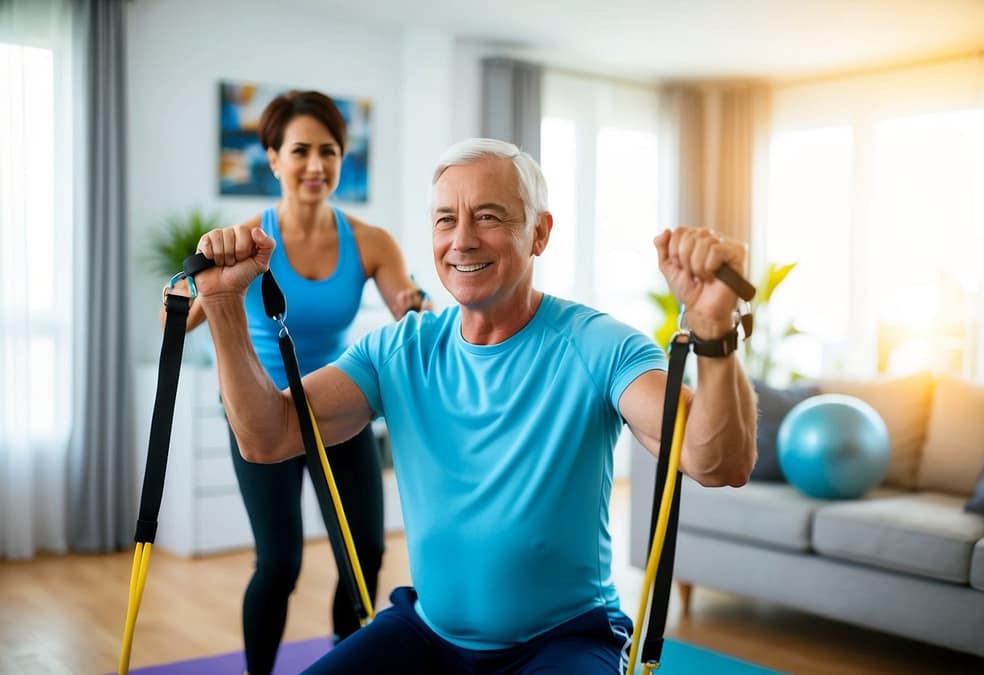
Most of the equipment that works for people over 60 fits in a closet. A recumbent bike is the one big purchase worth considering; everything else on this list is a band, a weight, a pad or a mat that lives under a bed or in a basket. This guide covers the twelve pieces of exercise equipment we would put in a New York apartment for an older adult, chosen for safety first and footprint second, plus the research behind why strength and balance work matter at this age, and the recalls and sizing details that decide whether a piece of equipment helps or hurts.
We have not tested these products in a lab. Our picks come from reviewers who tested them (OutdoorGearLab, Garage Gym Reviews, Tom’s Guide, NBC Select, Reviewed), from manufacturers’ specifications, and from the kind of equipment that fits a New York apartment or building gym. Product status, prices and recall status are as of October 2026. Links to Amazon are affiliate links, and Type A Training earns a commission if you buy through them, at no extra cost to you.
The short version
- Cardio: a Schwinn 290 recumbent bike if you have the floor space, a DeskCycle 2 pedal exerciser if you do not. For a treadmill, buy one with full handrails (Sole F63), not a walking pad.
- Strength: Bodylastics bands with a door anchor, a few pairs of neoprene dumbbells, Bala Bangles for wrists and ankles. Not an adjustable dumbbell: two brands have been recalled since mid-2025.
- Balance and floor work: a step platform, an Airex balance pad, a TheraBand slow-deflate stability ball, a one-inch mat for getting up and down.
- Recovery and hands: a soft 36-inch foam roller and a TheraBand FlexBar.
- Not exercise equipment but worth owning: a validated upper-arm blood pressure monitor.
Why strength and balance, according to the research
The 2019 Cochrane review of exercise and falls (Sherrington and colleagues, 108 trials, 23,407 people) found that exercise reduces the rate of falls in older adults living at home by about 23 percent and the number of people who fall by about 15 percent, and that the programs with high-certainty evidence are the ones built mainly on balance and functional exercises. The National Strength and Conditioning Association’s 2019 position statement (Fragala and colleagues) calls resistance training “a powerful intervention to combat the loss of muscle strength and muscle mass” in older adults, and, as summarized by IDEA Fitness, recommends two to three sessions a week. Grip strength on its own predicts future physical function, fractures and even mortality, which is why a 2019 review in Clinical Interventions in Aging (Bohannon) recommends measuring it routinely. And a 2021 meta-analysis in Clinical Rehabilitation (Luan and colleagues, 11 studies, 8 pooled) found stationary cycling reduced knee osteoarthritis pain against no exercise. The CDC’s guideline for adults 65 and over is 150 minutes a week of moderate activity, muscle-strengthening two days a week, and balance activities every week. Every pick below serves one of those three.
Before you buy anything
- Check with your doctor if you have an unstable medical condition, new or changing symptoms, or uncontrolled high blood pressure, and before anything vigorous. Light to moderate activity does not need a permission slip for most people without known heart, metabolic or kidney disease.
- Balance work happens within arm’s reach of support: a wall, a kitchen counter or the back of a heavy chair. Never on a thick soft mat.
- Chair-stand practice uses a 17-inch seat with no arms, against a wall. That is the setup of the CDC’s 30-second chair stand test, which is also a simple way to track leg strength over time.
- Do not walk or run in ankle weights. They are for seated and standing strength work, at 1 to 2 pounds to start.
- Treadmills need full handrails, a clipped safety key, and a rule never to step onto a moving belt.
Cardio
Schwinn 290 recumbent bike: best if you have the space
A recumbent bike supports your back, keeps your feet low and lets you read while you ride, which is why it is the one cardio machine worth the floor space. OutdoorGearLab named the Schwinn 290 its best recumbent bike: 330-pound capacity, 25 levels of magnetic resistance, a seat that slides over 13 inches, and a step-through height of about 4 inches. The footprint is the catch, about 65 by 29 inches, so measure first. Schwinn’s older 270 is out of production; the 290 is the current model. $799 list. The Nautilus R618 ($799 at Garage Gym Reviews, 325 pounds) is the near-twin from Nautilus, which shares a parent company with Schwinn; check that it is still in stock. And Garage Gym Reviews’ pick for seniors with back problems is Sunny Health’s Essential recumbent at under $300 with a lower 300-pound capacity and 8 resistance levels.
Schwinn 290 Recumbent Bike
330 lb capacity, 25 magnetic resistance levels, step-through frame, about 65 x 29 in. OutdoorGearLab’s best recumbent bike.
DeskCycle 2: best for a studio apartment
A pedal exerciser sits on the floor in front of a dining chair and gives you the same seated cycling in a 10 by 24 inch footprint. Garage Gym Reviews scored the DeskCycle 2 five out of five for construction and adjustability: 8 magnetic resistance levels, quiet enough for a phone call, and a pedal height of 9 or 10 inches on the adjustable version. Put the chair’s back against a wall so the unit cannot push it backward; pedal exercisers like these can also be set on a table for seated arm cycling. About $160 for the adjustable version. Sunny Health’s SF-B0891 ($99.99) is the lighter budget version with a carry handle.
DeskCycle 2 Under Desk Bike Pedal Exerciser
8 magnetic resistance levels, quiet, 10 x 24 in footprint, adjustable pedal height. Use from a sturdy chair against a wall.
Sole F63 treadmill: if you want a treadmill, this is the kind
Walking pads are the wrong tool for anyone whose balance is in question. Of the seven walking pads Woman and Home recommends after testing more than ten, only three come with a handrail, and in April 2026 the Consumer Product Safety Commission warned people to stop using Sperax walking pads after 201 reports of sudden speed changes and stops, at least 66 falls or injuries, and 573 reports of overheating, with the importer refusing a recall. If you want a treadmill at home, buy one with full side rails and a crossbar: the Sole F63 has them, a 325-pound capacity, a 20 by 60 inch cushioned deck, and it folds upright. It is also 224 pounds and 8 inches off the floor at the deck, so it needs delivery, assembly and a floor mat. About $1,100 to $1,300 depending on Sole’s promotions (it was $1,099.99 in Sole’s October 2026 sale). The folding UREVO 2-in-1 ($300) is one of the few compact folding treadmills with a rail at all, and OutdoorGearLab listed its “floppy handle” as a reason to avoid it, so it is for steady walkers who want something to touch, not for fall prevention.
Sole F63 Treadmill
Full handrails and crossbar, 325 lb capacity, 20 x 60 in cushioned deck, 0 to 15 percent incline, folds upright. Heavy; plan on delivery and assembly.
Strength
Bodylastics resistance bands: the one piece we would buy first
Bands do what a cable machine does, in a drawer. Bodylastics’s five-band set is Tom’s Guide’s best overall resistance band and a 4.6 at Garage Gym Reviews, and it is the set we recommend for older adults for one reason: the lightest band is 3 pounds, where many tube sets start at 10, which is the right load for a rotator cuff or a first seated row. Each band has an inelastic cord inside it (Bodylastics calls it Snap Guard) that stops it over-stretching, and the kit includes a door anchor, handles and ankle straps. About $40. They are latex; TheraBand’s non-latex flat bands are the alternative for allergies, and Fit Simplify’s mini loops cover seated hip work for about ten dollars. Inspect handles now and then: a small HomeProGym band recall in May 2026 was for handles separating from the band.
Bodylastics Resistance Bands Set with Handles and Door Anchor
Five stackable bands from 3 lb, anti-snap inner cord, door anchor, handles, ankle straps. Tom’s Guide’s best overall.
Amazon Basics neoprene dumbbells: fixed weights, not adjustable
Two pairs of adjustable dumbbells popular in home gyms have been recalled since mid-2025: the Bowflex SelectTech 552 and 1090 in June 2025 (3.8 million units, plates that detach, 111 injuries) and the Tzumi FitRx in April 2026 (plates that dislodge, broken toes and lacerations). The Bowflex also starts at 5 pounds and is nearly 17 inches long, which is the wrong tool for a 2-pound shoulder raise. Buy fixed neoprene dumbbells instead: Amazon Basics sells them by the pair from 1 pound in 1-pound steps to 10, OutdoorGearLab named them its best beginner dumbbells, the hexagonal ends stop them rolling and the neoprene is easy to grip, and a 2, 3, 5 and 8 pound set covers most programs and lives in a basket. About $17 for a 5-pound pair.
Amazon Basics Neoprene Dumbbells
Sold by the pair from 1 lb in 1 lb steps. Hexagonal ends, grippy neoprene, no moving parts. OutdoorGearLab’s best beginner dumbbells.
Bala Bangles: wearable weight for wrists and ankles
Bala Bangles won NBC Select’s Wellness Award for best ankle weights (March 2026): a fixed half pound, 1 or 2 pounds of recycled stainless steel in silicone, with a Velcro strap that Reviewed found stayed put without chafing. They go on the wrists for seated arm work and on the ankles for leg raises and clamshells, and they are light enough that a coach quoted by NBC Select recommends them for Pilates-based work. Not for walking in. $55 for the 1-pound pair, $65 for 2 pounds. Sportneer’s adjustable set (about $31) is NBC Select’s pick if you want to add load over time.
Bala Bangles Wrist and Ankle Weights, 1 lb pair
Fixed 1 lb (or 2 lb) stainless steel in silicone, Velcro strap, stays put. NBC Select’s Wellness Award winner for ankle weights. Not for walking.
Balance and floor work
The Step Original: for stairs and curbs
Step-ups are the drill that transfers most directly to the subway stairs and the curb at the corner. The Step Original is the studio platform: 43 by 16 inches, 4 inches high alone and 6 or 8 with its risers, with a 350-pound capacity for the platform and 500 with risers. Start at 4 inches beside a wall or counter. $37 to $125 depending on how many risers you buy.
The Step Original Aerobic Platform
43 x 16 in platform, 4, 6 or 8 in with risers, 350 lb capacity (500 lb with risers), non-skid feet, made in the USA.
Airex Balance Pad: the clinical standard
A balance pad is a 2.5-inch slab of closed-cell foam that makes standing on two feet work again. The Airex is the pad you will see in physical therapy clinics, Swiss-made, 19 by 16 inches, used barefoot, and Garage Gym Reviews calls it the best-selling balance pad on the market. Use it within reach of a counter, progress from fingertips on the counter to hands hovering, and never stack it on a mat. About $100 to $117. ProsourceFit’s TPE pad ($23 to $30) is the budget version.
Airex Balance Pad
19 x 16 x 2.5 in closed-cell foam, non-slip, the pad used in physical therapy clinics. Always within reach of a wall or counter.
TheraBand Pro Series SCP stability ball: sized by height, slow to deflate
For an older adult the number that matters on a stability ball is not the burst rating but what happens when it is punctured. TheraBand’s Pro Series SCP deflates slowly instead of popping, carries a 600-pound static rating, and is sold by height: 55 cm for 5 foot 1 to 5 foot 6, 65 cm for 5 foot 7 to 6 foot 1, 45 cm below that and 75 cm above. Seated, your knees should sit level with or slightly below your hips. $44 for the 55 cm, $63 for the 65 cm.
TheraBand Pro Series SCP Exercise Ball
Slow-deflate construction, 600 lb static capacity, sized by height (55 cm for 5 ft 1 to 5 ft 6; 65 cm for 5 ft 7 to 6 ft 1).
BalanceFrom GoCloud 1-inch mat: for getting down and up
Getting down to the floor and back up is a skill worth practicing, and it is kinder on knees and wrists on a one-inch mat than on a yoga mat. BalanceFrom’s 71 by 24 inch high-density foam mat weighs about 2 pounds and rolls up with a strap. The caveat: it is too soft to stand on for balance drills, so standing work goes on the bare floor or a thin mat like Gorilla Mats’ quarter-inch 6 by 4 foot mat. About $31 to $35.
BalanceFrom GoCloud 1-inch Extra Thick Exercise Mat
71 x 24 in, 1 in high-density foam, about 2 lb, carrying strap. For floor work only; too soft for standing balance drills.
Recovery and hands
OPTP PRO-ROLLER Soft: a roller that does not hurt
Firm rollers are miserable on the thin tissue over an older adult’s shins and hips. OPTP, a physical therapy and rehab products supplier, makes its PRO-ROLLER in a soft density in EVA foam; the 36 by 6 inch size lies stable on the floor for lying along it to open the chest and for seated calf rolling without balancing on it. $32 to $51 depending on size. Tom’s Guide’s pick for beginners is GoFit’s 36-inch roller at about $42, and TriggerPoint’s CORE is the compact moderate-density option from $23.
OPTP PRO-ROLLER Soft Foam Roller, 36 x 6 in
Soft-density EVA from a physical therapy supplier. Full length for lying along it and seated rolling. Gentle on thin tissue.
TheraBand FlexBar: for grip and forearms
Grip strength is the one number on this page that predicts the most, and it is trainable at any age. The TheraBand FlexBar is Garage Gym Reviews’ pick for forearms, a rubber bar you twist and bend, sold in four resistances; older adults start at Extra Light or Light. Prohands’s Gripmaster, which loads each finger separately from under a pound, is the alternative for hands that need to work one finger at a time. $15 and up.
TheraBand FlexBar, Extra Light or Light
Twist-and-bend rubber bar for grip and forearm strength. Start with Extra Light (yellow) or Light (red).
Not exercise equipment, but buy one: a validated blood pressure monitor
For clients with hypertension, a reading before the session helps decide how hard to work that day. Buy an upper-arm cuff that appears on the US Blood Pressure Validated Device Listing at validatebp.org, which is supported by the American Medical Association and reviewed by an independent committee; FDA clearance alone does not mean a monitor is accurate, and the American Heart Association does not recommend wrist or finger monitors. Omron lists its Platinum (BP5450) and 10 Series (BP7450) on that listing; both store two users’ readings and average three readings. Buy the BP5450 by model number: Omron’s newer Platinum, the BP5465, does not appear on the validated listing as of October 2026. Check the cuff size against your arm, measure seated after five minutes of rest, and bring the log to your doctor. About $90 to $120.
Omron Platinum Upper Arm Blood Pressure Monitor (BP5450)
Upper-arm cuff, on the US Validated Device Listing per Omron, two users, three-reading average, large backlit display.
One more thing that is not equipment: fall detection. AARP’s September 2026 review of medical alert systems says no fall detection is 100 percent accurate, and about 72 percent of its surveyed users said it worked as it should. An Apple Watch has it built in; our Apple Watch for seniors guide covers which models.
What happened to the old picks
- Ab machines and stretch machines: dropped. Neither has a place in an apartment or in an older adult’s program; a band, a mat and a chair do both jobs.
- Adjustable dumbbells: dropped after two recalls (Bowflex 552 and 1090, June 2025; Tzumi FitRx, April 2026).
- Walking pads: not recommended, and after the April 2026 CPSC warning on Sperax pads, named as what to avoid.
- Amazon Basics foam roller: replaced. It is a firm roller, and firm is the wrong density for this audience.
- The Gaiam yoga mat: moved to our yoga accessories guide; for floor-to-stand practice a one-inch mat is the better tool.
Equipment is the easy part
Every item here works only if it is used two or three times a week with a program that progresses, and that is the hard part at any age. A trainer who comes to you builds the program around the equipment you own, the floor you have and the stairs you climb, and tracks the chair stand and the grip number over months. Type A Training’s in-home trainers for seniors come to your home, your building gym or a park in Manhattan, bring any equipment you need and build the program around your goals and your schedule. Learn more about in-home personal training, and see our strength training exercises for seniors and senior fitness safety guide for the exercises that go with this equipment.
Frequently asked questions
What is the best exercise equipment for seniors at home?
A set of resistance bands with a door anchor, two or three pairs of light dumbbells and a balance pad cover strength and balance for about $200 (or about $100 with the ProsourceFit pad instead of the Airex) and fit in a closet. Add a recumbent bike or a pedal exerciser for cardio.
Is a recumbent bike or a treadmill better for seniors?
A recumbent bike for most people: it supports the back, the feet stay low, and there is nothing to fall off. A treadmill only with full handrails and a safety key, never a walking pad without rails.
How heavy should dumbbells be for a beginner over 60?
Light enough to finish 10 to 15 controlled repetitions with good form, which for many people means 2 to 5 pounds for the shoulders and 5 to 10 for rows and presses. The NSCA position statement, as summarized by IDEA Fitness, recommends beginners start with higher repetitions at low intensity and add load gradually.
Are ankle weights safe for seniors?
For seated and standing strength work at 1 to 2 pounds, yes. Not for walking or running: the extra load changes your gait and stresses the knees, hips and lower back.
Do I need to see a doctor before starting?
If you have an unstable medical condition, new or changing symptoms, or uncontrolled high blood pressure, yes, and before any vigorous exercise. For light to moderate activity, most people can start and build up gradually.
Patient trainers who specialize in balance, strength, and confidence, in your own home.
Explore senior training