This comprehensive guide has been fully revised with new bedtime yoga poses, updated sleep research, and enhanced techniques specifically for insomnia relief.
TL;DR
Incorporating yoga in schools improves students’ focus, academic performance, emotional regulation, and physical health while reducing stress and anxiety. This evidence-based holistic practice fosters better classroom behavior, enhances self-esteem, and develops essential life skills like self-awareness and stress management. Schools can successfully integrate yoga through affordable, sustainable programs, trained teachers, and flexible formats that accommodate diverse student needs—with initial costs as low as $500-2,000.
Benefits of Yoga in Schools: A Holistic Approach to Education
Yoga is becoming increasingly popular in schools, and for good reason. Incorporating yoga into the daily routine can offer numerous benefits for students’ mental, emotional, and physical well-being. By integrating this ancient practice into the curriculum, schools can provide a holistic approach to education, fostering the development of the whole child.
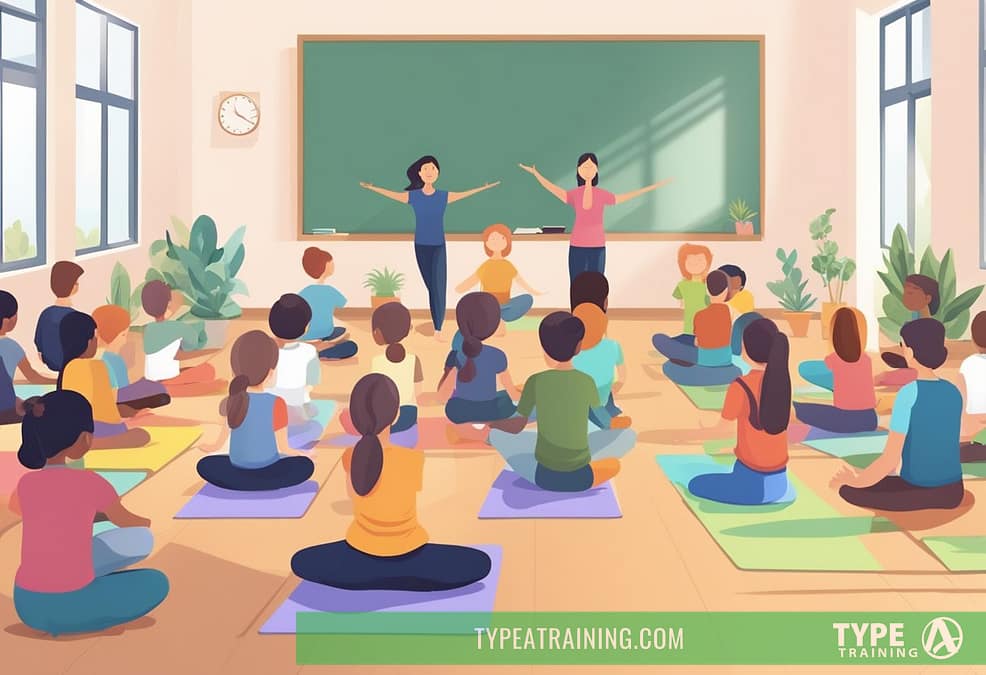
Incorporating yoga in schools has been shown to improve students’ focus, memory, self-esteem, academic performance, and classroom behavior, as well as reduce anxiety and stress. As a student, you can experience a sense of calm and increase your ability to handle the various challenges that may arise in the classroom and beyond. Furthermore, yoga has physical benefits such as improved strength, flexibility, and balance, making it an ideal choice for promoting overall health.
By including yoga in the school setting, educators acknowledge the importance of nurturing not just the intellect but also the mind-body connection. Through regular practice, students can develop essential life skills such as self-awareness, stress management, and emotional resilience, helping them navigate the complexities of their educational journey with greater ease and confidence.
Popular posts:
Physical and Mental Health Benefits of Yoga for Students
How Yoga for Students Improves Focus and Concentration
Yoga can help improve your focus and concentration in school. Practicing yoga and mindfulness can lead to better mental health and cognitive performance. Specific poses, such as the Tree Pose and the Seated Forward Bend, promote balance and concentration. Incorporating deep breathing techniques into your yoga routine can also enhance focus, allowing your mind to become calm and more focused.
Enhancing Flexibility and Posture
Practicing yoga can lead to improved flexibility and posture. Yoga poses such as the Downward Dog and the Cobra Pose can help in developing your physical strength, which in turn can improve your balance, endurance, and aerobic capacity in school. By strengthening different muscle groups, yoga can significantly help in correcting posture-related issues and promoting overall physical health.
Promoting Relaxation and Stress Management
Yoga can be an effective tool for managing stress and anxiety. Engaging in yoga and mindfulness practices helps you to develop better emotion regulation and coping mechanisms. The practice of yoga can induce relaxation by incorporating poses such as the Child’s Pose and Legs-Up-the-Wall Pose. These poses, in conjunction with deep breathing exercises, help you to achieve mental and emotional relaxation, leading to better stress management in your academic and personal life.
Educational Outcomes and Classroom Environment
Boosting Academic Performance
One of the benefits of incorporating yoga into the school day is its potential to boost academic performance. Research suggests that school-based yoga may benefit students’ self-regulation — the ability to monitor and adapt their behavior, emotions, and attention in response to internal cues, the environment, and feedback from others. By improving self-regulation, students can better focus and engage in the learning process. Yoga has been shown to improve balance, strength, endurance, and aerobic capacity in children, which may contribute to enhanced cognitive abilities, such as memory and attention.
Fostering Better Classroom Behavior
Implementing a daily yoga practice in the classroom can also improve classroom behavior, as it has been reported to reduce stress and bullying behaviors. When students regularly practice yoga, it helps create a calmer and more harmonious atmosphere in the classroom.
Some common techniques used in classroom yoga include:
- Breathing exercises: incorporating deep and mindful breathing to help calm the mind.
- Physical poses: stretching and posture exercises to improve balance, strength, and flexibility.
- Relaxation techniques: guided imagery or meditation to focus the mind and relieve stress.
These activities help students develop self-awareness and self-control, leading to improved behavior and smoother classroom dynamics.
Supporting Emotional and Social Learning
Yoga in education not only provides physical and cognitive benefits but also offers valuable support for emotional and social learning. As students learn to manage their emotions through yoga and mindfulness practices, they can develop better social skills and improve their relationships with peers and teachers. Yoga can also affect students’ self-esteem and confidence, enhancing their ability to deal with challenges and setbacks in both academic and personal contexts.
To integrate yoga into your school’s curriculum, consider the following:
- Train teachers: Equip educators with the knowledge and skills to lead yoga sessions in the classroom.
- Create a safe space: Ensure the classroom environment is welcoming and supportive for all students to practice yoga.
- Schedule regular yoga sessions: Incorporate yoga into the daily routine, allowing time for students to develop and practice these skills consistently.
By incorporating the benefits of yoga into the classroom environment, you can support your students in achieving better educational outcomes and foster a more positive learning experience for everyone involved.
Age-Appropriate Yoga Practices: Elementary, Middle, and High School
Yoga for Elementary School Students (Ages 5-11)
Elementary students benefit from playful, story-based yoga sessions that incorporate animal poses and imaginative themes. Sessions should be 15-20 minutes with high energy poses like Cat-Cow, Butterfly, and Happy Baby. Use games, songs, and storytelling to maintain engagement while teaching basic breathing techniques.
Yoga for Middle School Students (Ages 11-14)
Middle schoolers can handle more structured 20-30 minute sessions focusing on stress management and body awareness during puberty. Introduce more challenging poses like Warrior sequences and Sun Salutations, along with mindfulness practices that address peer pressure, self-esteem, and emotional regulation.
Yoga for High School Students (Ages 14-18)
High school students benefit from 30-45 minute sessions that address test anxiety, college stress, and athletic performance. Advanced poses, meditation techniques, and breathing exercises for exam preparation help students develop lifelong wellness habits. Focus on stress management tools they can use independently.
Integrating the Benefits of Yoga in Schools: Curriculum Implementation
Developing a Sustainable Yoga Program
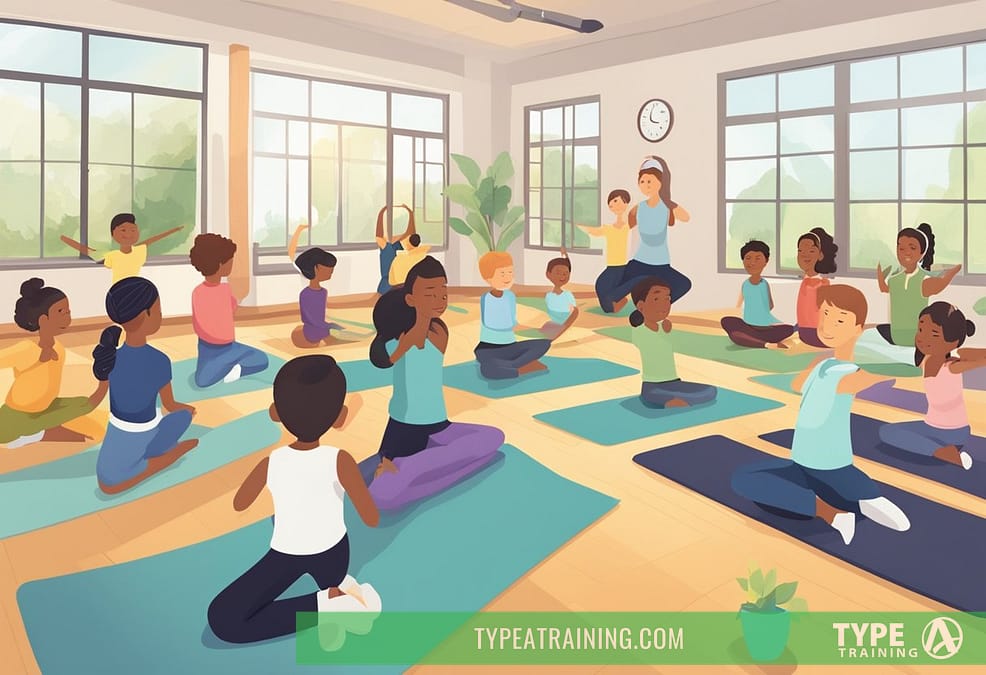
To integrate yoga into your school’s curriculum effectively, it’s essential to create a sustainable yoga program. This involves setting clear objectives, aligning the program with your school’s overall curriculum and goals, and obtaining support from the school administration, staff, and parents. One approach to integrating yoga is to add it as part of your school’s physical education classes, promoting physical and mental well-being among students.
Plan your program by considering the available time slots, class settings, and duration of each session. Also, identify student needs, such as special considerations for individuals with disabilities or specific health concerns. Developing a structured and well-planned program will ensure a smooth integration and enable the benefits of yoga to reach your students effectively.
Consider incorporating various formats, such as guided group practices, individualized instruction, or online resources to cater to diverse learning styles. This flexibility will not only improve students’ engagement but also accommodate the varying requirements of school schedules.
Teacher Training and Resources
Another critical aspect of integrating yoga into your school’s curriculum is ensuring that educators receive proper training and have access to appropriate resources. Identifying credentialed and experienced yoga instructors can significantly contribute to your program’s success. Offering regular training to your physical education teachers or having a dedicated yoga instructor within the school can make a lasting positive impact on students’ well-being.
In addition to training, provide educators with resources to further their knowledge and implementation of yoga practices. This can include access to online courses, books, or community-based workshops. Encourage teacher involvement in creating and refining the program, fostering a sense of ownership and enthusiasm. Providing support for educators allows them to develop the necessary skills to effectively teach yoga and maximize its benefits for students.
Remember, incorporating yoga into your school’s curriculum is a valuable investment in students’ physical and mental health, potentially enhancing their overall academic experience. By developing a sustainable yoga program and investing in teacher training and resources, you can effectively bring the life-enhancing practice of yoga to your students.
Sample Yoga Class Structure for Schools: A 20-Minute Lesson Plan
Opening (3 minutes)
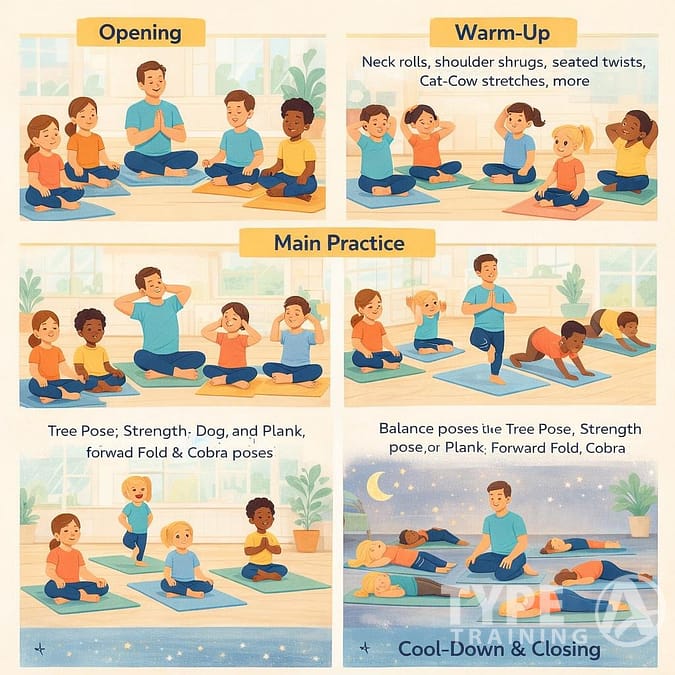
Begin with students seated in a comfortable position. Lead a brief check-in where students can share how they’re feeling. Start with 2-3 minutes of simple breathing exercises like belly breathing or counting breaths to transition from academic mode to mindful practice.
Warm-Up (4 minutes)
Guide students through gentle movements like neck rolls, shoulder shrugs, seated twists, and Cat-Cow stretches. Use this time to explain the importance of listening to their bodies and moving at their own pace while establishing a safe, judgment-free environment.
Main Practice (10 minutes)
Lead 5-7 yoga poses appropriate for the age group and space available. Include a balance pose (Tree), strength poses (Downward Dog, Plank), and flexibility poses (Forward Fold, Cobra). Hold each pose for 30-60 seconds with clear verbal cues and demonstrations.
Cool-Down and Closing (3 minutes)
End with a relaxation pose like Child’s Pose or brief guided visualization. Have students lie down for 1-2 minutes of rest while you guide them through a body scan or positive affirmations. Close with three deep breaths and a moment of gratitude.
Cost of Implementing Yoga Programs in Schools: Budget Planning
Initial Setup Costs
Starting a school yoga program requires minimal investment compared to other physical education programs. Basic costs include budget-friendly classroom yoga mats ($10-30 each for 25-30 students = $250-900), storage solutions ($50-200), and instructional materials like posters and cards ($50-150). Total initial investment typically ranges from $500-2,000 for a classroom-sized program.
Ongoing Program Expenses
Annual costs vary based on your chosen model. Hiring a certified yoga instructor costs $40-100 per session (2-3 times weekly = $3,000-12,000 annually). Alternatively, training existing PE teachers through 50-hour children’s yoga certification programs costs $500-1,500 per teacher, with ongoing professional development at $200-500 annually. Digital subscriptions for online resources range from $100-500 per year.
Grant Opportunities and Funding Sources
Many schools successfully fund yoga programs through wellness grants, PTA fundraising, community partnerships with local yoga studios, and donations from health-focused organizations. Title I schools may qualify for federal wellness program funding, while private foundations often support mental health and mindfulness initiatives in education.
Yoga in Schools Resources: Tools for Success
Recommended Training Programs
- YogaKids: Comprehensive teacher training for ages 3-12
- Yoga Ed.: Standards-based curriculum with classroom management focus
- Little Flower Yoga: Trauma-informed approach for diverse populations
- Yoga Calm: Evidence-based program emphasizing emotional regulation
Books and Curriculum Guides
- “Yoga Calm for Children” by Lynea Gillen and Jim Gillen
- “Classroom Yoga Breaks” by Michelle Chiantella
- “Teaching Yoga Beyond the Poses” by Sage Rountree and Alexandra DeSiato
- “Yoga for Children with Autism Spectrum Disorders” by Dion E. Betts and Stacey W. Betts
Online Platforms and Apps
- Cosmic Kids Yoga: Free YouTube channel with 200+ storytelling yoga adventures for ages 3-10
- GoNoodle: Free movement and mindfulness videos for classroom brain breaks
- Headspace for Educators: Free meditation app with dedicated teacher and student content
- Move This World: SEL platform combining movement, mindfulness, and breathing exercises
- Calm Schools: Free mindfulness resources designed for K-12 environments
- Breathe, Think, Do with Sesame: Free app teaching self-control through breathing games
Professional Organizations
- Yoga Alliance: International credentialing organization for certified children’s yoga teachers
- Mindful Schools: Leading organization for teacher training and mindfulness curriculum
- CASEL: Framework for integrating yoga within social-emotional learning programs
- Yoga Service Council: Network supporting yoga programs for underserved populations
Essential Equipment and Supplies
Must-Have Items:
- Yoga Mats: Budget bulk options at $10-15 each (plan for 25-30 mats = $250-450)
- Storage Solutions: Rolling carts ($50-150) or wall racks ($30-100)
- Instructional Posters: Visual pose charts ($15-40)
- Timer/Bell: Gentle chime or meditation timer ($10-25)
Nice-to-Have Items:
- Yoga Blocks: Foam blocks at $5-12 each (start with 10-15)
- Bolsters: Supportive props at $15-40 each (5-10 per classroom)
- Blankets: Fleece blankets at $5-10 each for relaxation
- Straps: Yoga straps at $4-8 each (10-15 for most classrooms)
- Breathing Buddies: Small stuffed animals ($3-8) for belly breathing visualization
Grant and Funding Opportunities
- Local Education Foundation Grants: Community foundations offer $500-$5,000 for wellness programs
- PTA/PTO Funding: Parent organizations often allocate $1,000-$3,000 for health initiatives
- State Wellness Grants: Check your state’s Department of Education for PE and mental health funding
- Corporate Partnerships: Companies like Lululemon and local yoga studios sponsor school programs
- DonorsChoose: Crowdfunding platform for yoga mats, props, and teacher training expenses
- Title I & IV Funds: Federal funds can support well-rounded education initiatives including yoga
Free Printable Resources
- Pose Sequence Cards: Printable cards for building custom yoga flows by grade level
- Breathing Exercise Guides: Visual instructions for belly breathing, lion’s breath, and more
- Parent Permission Forms: Customizable consent forms explaining program benefits
- Assessment Rubrics: Tools for measuring student progress in physical skills and mindfulness
- Attendance Trackers: Simple logs for monitoring participation and engagement
- Calm Corner Posters: Visual reminders for self-regulation techniques and breathing strategies
💡 Resource Tip: Start small! You don’t need everything at once. Begin with basic mats and free online resources, then gradually expand your program as you secure additional funding and see what works best for your students.
Research Studies and Evidence Base
Share these peer-reviewed studies with administrators and stakeholders to build support for your program:
- Journal of Developmental & Behavioral Pediatrics (2013): School-based yoga reduced anxiety and improved emotional balance in 51 third-graders
- Psychology Research and Behavior Management (2012): Hostile yoga program decreased aggressive behaviors and increased self-control in elementary students
- Journal of Behavioral Health Services & Research (2018): Trauma-informed yoga improved attention and reduced stress in urban schools
- Advances in School Mental Health Promotion (2015): Mindfulness-based yoga enhanced academic performance and reduced test anxiety
- International Journal of Yoga (2020): Regular yoga practice improved executive function and cognitive flexibility in middle school students
Sample Implementation Schedules
Elementary School (15-Minute Morning Routine):
- Minutes 1-3: Arrival breathing and centering
- Minutes 4-10: 5-6 energizing poses (Sun Salutations, Warrior series)
- Minutes 11-13: Balance poses and focus practice
- Minutes 14-15: Brief relaxation and intention setting
Middle School (20-Minute Midday Reset):
- Minutes 1-5: Breathing techniques and stress release
- Minutes 6-14: Flowing sequence with strength-building poses
- Minutes 15-17: Stretching and flexibility work
- Minutes 18-20: Guided meditation or body scan
High School (30-Minute Elective Class):
- Minutes 1-5: Check-in circle and breathing practice
- Minutes 6-20: Full yoga flow with pose variations and challenges
- Minutes 21-25: Deep stretching or restorative poses
- Minutes 26-30: Extended relaxation (Savasana) and reflection
Bringing It All Together: Your Yoga for Students Journey
Implementing yoga for students in your school isn’t just about teaching poses—it’s about creating a foundation for lifelong wellness, resilience, and self-awareness. Whether you’re a classroom teacher incorporating 5-minute breathing breaks, a PE instructor developing a full yoga unit, or an administrator building a school-wide mindfulness program, every small step makes a meaningful difference in students’ lives.
The research is clear: yoga improves academic performance, reduces behavioral issues, enhances emotional regulation, and builds physical health. But beyond the data, you’ll witness the transformation firsthand—the anxious student who learns to calm their racing thoughts, the hyperactive child who discovers focus through movement, the shy teen who finds confidence in their body’s strength.
Start where you are with what you have. You don’t need a perfect space, expensive equipment, or advanced training to begin. Use the free resources outlined in this guide, adapt lessons to fit your unique classroom needs, and trust that even brief moments of mindful movement create ripple effects that extend far beyond the yoga mat.
The students in your care deserve tools to navigate stress, build resilience, and connect with their bodies and minds. By bringing yoga into their educational experience, you’re giving them skills they’ll carry into adulthood—and creating a calmer, more focused, more compassionate learning environment for everyone. Your journey starts now. Take a deep breath, and let’s begin.
🧘 Ready to Get Started? Go to Type a Trainings Corporate Wellness Programs that can help bring Yoga to your school!
Key Takeaways: Yoga for Students
- Cognitive and Academic Benefits: School-based yoga improves students’ focus, memory, concentration, and academic performance by enhancing self-regulation and cognitive abilities through practices like Tree Pose, deep breathing, and mindfulness techniques.
- Physical Health Improvements: Regular yoga practice develops strength, flexibility, balance, posture, and aerobic capacity through poses like Downward Dog, Cobra Pose, and Seated Forward Bend—all without requiring expensive equipment or special facilities.
- Mental Health and Stress Reduction: Yoga provides effective, evidence-based tools for managing stress and anxiety through relaxation poses (Child’s Pose, Legs-Up-the-Wall) combined with deep breathing exercises, helping students develop better emotion regulation and lifelong coping mechanisms.
- Enhanced Classroom Environment: Daily yoga practice creates a calmer, more harmonious classroom atmosphere by reducing bullying behaviors, improving self-control, and fostering better behavior through structured breathing exercises, physical poses, and relaxation techniques.
- Social-Emotional Development: Yoga supports emotional intelligence and social learning by helping students develop self-awareness, confidence, self-esteem, empathy, and improved relationships with peers and teachers while building resilience to handle academic pressures and personal challenges.
- Age-Appropriate Programming: Effective yoga programs adapt to developmental stages—elementary students (15-20 min playful sessions), middle schoolers (20-30 min stress management focus), and high schoolers (30-45 min advanced practice with meditation and exam stress techniques).
- Affordable Implementation: Schools can launch yoga programs with minimal investment ($500-2,000 initial setup) using budget-friendly mats, free online resources, and existing PE teachers trained through 50-hour certification programs ($500-1,500), with grant funding available from PTAs, wellness foundations, and Title IV federal programs.
- Flexible Integration Models: Successful programs incorporate diverse formats—morning routines, PE class components, lunch mindfulness breaks, after-school clubs, or full elective courses—using a mix of guided group practices, individualized instruction, and digital resources to accommodate different learning styles, school schedules, and student needs including those with disabilities or trauma backgrounds.
Frequently Asked Questions
What are the benefits of yoga in schools for students?
Yoga in schools provides comprehensive benefits including improved focus, memory, academic performance, and classroom behavior, while reducing anxiety and stress. Students who practice yoga regularly develop better self-regulation—the ability to monitor and adapt their behavior, emotions, and attention in response to internal cues and environmental feedback.
Physical benefits include enhanced strength, flexibility, balance, endurance, and aerobic capacity. On an emotional level, yoga helps students develop self-awareness, confidence, self-esteem, and emotional resilience, equipping them with essential life skills to navigate academic and personal challenges with greater ease.
How does yoga improve students’ focus and concentration in the classroom?
Yoga improves focus and concentration through specific poses and breathing techniques that calm the mind and enhance cognitive performance. Poses like Tree Pose and Seated Forward Bend promote balance and concentration, while deep breathing exercises help students achieve a calm, focused mental state that translates to better classroom engagement.
Research shows that practicing yoga and mindfulness leads to better mental health and cognitive performance. By incorporating these practices into the school day, students develop stronger self-regulation skills, allowing them to better monitor their attention and maintain focus during lessons and academic tasks.
What yoga poses are best for students in schools?
The best yoga poses for students include Tree Pose and Seated Forward Bend for concentration and balance, Downward Dog and Cobra Pose for developing physical strength and flexibility, and Child’s Pose and Legs-Up-the-Wall Pose for relaxation and stress relief. These poses are specifically chosen because they can be safely practiced in classroom settings and provide multiple benefits.
Each pose serves a distinct purpose: balancing poses enhance focus, strength-building poses improve posture and correct posture-related issues, and relaxation poses help with stress management. When combined with deep breathing exercises, these poses create a comprehensive practice that addresses students’ physical, mental, and emotional needs throughout the school day.
How can schools integrate yoga into their curriculum effectively?
Schools can effectively integrate yoga by developing a sustainable program with clear objectives aligned to curriculum goals, training teachers or hiring credentialed yoga instructors, and creating safe, welcoming spaces for practice. The program should be incorporated into physical education classes or scheduled as regular sessions, with consideration for available time slots, class settings, and session duration.
Successful implementation requires obtaining support from school administration, staff, and parents, while also identifying student needs including special considerations for disabilities or health concerns. Schools should offer various formats such as guided group practices, individualized instruction, and online resources to accommodate diverse learning styles and school schedules, ensuring flexibility and maximum student engagement.
Does yoga help reduce stress and anxiety in students?
Yes, yoga is highly effective at reducing stress and anxiety in students by promoting relaxation through specific poses and breathing exercises. Relaxation poses like Child’s Pose and Legs-Up-the-Wall Pose, combined with deep breathing techniques, help students achieve mental and emotional relaxation, leading to better stress management in both academic and personal contexts.
Regular yoga practice helps students develop better emotion regulation and coping mechanisms, essential skills for handling the various challenges that arise in school. By creating a calmer classroom atmosphere and reducing bullying behaviors, yoga contributes to an overall reduction in student stress levels while building emotional resilience that extends beyond the classroom environment.
How does yoga improve classroom behavior and reduce bullying?
Yoga improves classroom behavior by helping students develop self-awareness and self-control through regular practice of breathing exercises, physical poses, and relaxation techniques. Research shows that implementing daily yoga practice reduces stress and bullying behaviors, creating a calmer and more harmonious classroom atmosphere where students can better focus on learning.
The practice helps students manage their emotions more effectively, leading to improved social skills and better relationships with peers and teachers. By incorporating guided imagery, meditation, and mindful breathing into the classroom routine, students learn to respond to challenges with greater composure and empathy, resulting in smoother classroom dynamics and reduced conflict.
What training do teachers need to teach yoga in schools?
Teachers need proper training from credentialed and experienced yoga instructors to effectively teach yoga in schools. Schools can offer regular training to physical education teachers or hire dedicated yoga instructors who understand how to adapt practices for children and classroom settings, ensuring the program’s success and safety for all students.
Beyond initial training, educators should have access to ongoing resources such as online courses, books, and community-based workshops to further their knowledge and implementation skills. Encouraging teacher involvement in creating and refining the program fosters ownership and enthusiasm, while providing support enables educators to develop the necessary skills to maximize yoga’s benefits for students’ physical and mental well-being.